
Being falsely accused in Pennsylvania is one of the most terrifying experiences a person can go through. You may feel a profound sense of shock and disbelief. Because you know you are innocent, you might assume the truth will naturally come to light, and the situation will simply resolve itself. Unfortunately, the justice system does not automatically filter out lies from the truth the moment an allegation is made.
The reality is that a false accusation triggers a very real and overwhelming legal process. An untrue statement from a single individual can be enough for law enforcement to secure a warrant and initiate formal criminal proceedings. In an instant, your reputation, your career, and your personal freedom are placed at significant risk, forcing you to defend your life against something you did not do.
When facing fabricated charges, sitting back and waiting for the system to realize its mistake is a legally perilous approach. You must take immediate, proactive steps to protect yourself before the prosecution builds a case against you. Let’s break down exactly how false allegations escalate in Pennsylvania and the critical legal steps you need to take to prove your innocence and clear your name in Pennsylvania criminal courts.
What Does “Falsely Accused” Actually Mean Under Pennsylvania Law
In the context of the criminal justice system, being falsely accused means that someone has made an untrue claim to law enforcement, an employer, or the public, asserting that you committed an illegal act.
These fabrications stem from a variety of sources. They may be the result of a genuine misunderstanding or a case of mistaken identity. However, they are frequently malicious. False claims often arise during contentious divorces, heated child custody battles, or out of a desire for personal revenge.
Regardless of the accuser’s underlying motive, law enforcement is generally required to take allegations of criminal conduct seriously and investigate them accordingly. This dynamic often immediately leads to complex witness credibility disputes between the accuser and the accused.
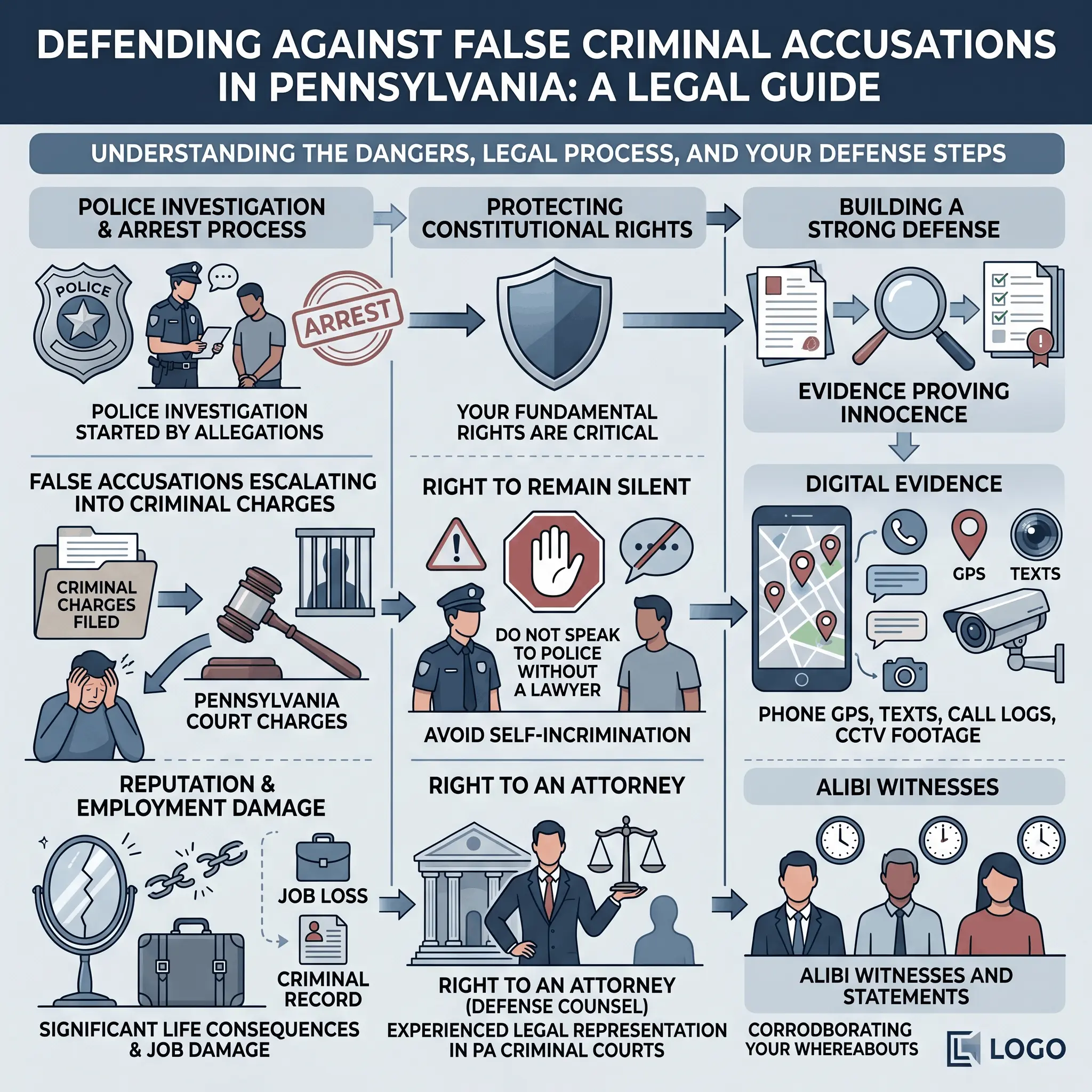
How a False Accusation Can Quickly Become a Real Criminal Case
Many people are shocked to discover how quickly an unsubstantiated lie can turn into a formal criminal prosecution. The progression from a mere statement to a courtroom battle typically follows a standard path.
When Police Get Involved
When a complaint is filed, police officers will begin an investigation. It is crucial to understand that police do not need absolute, undeniable proof to make an arrest. They only need “probable cause” – a reasonable belief that a crime was committed and that you committed it. In some cases, a sworn statement from an accuser may be sufficient for law enforcement to establish probable cause, depending on the circumstances and credibility assessments.
How Prosecutors Decide to Press Charges
Once the police file their report, the local District Attorney’s office reviews the information to decide whether to formally press charges. Pennsylvania prosecutors often proceed with cases even if the physical evidence is limited, particularly in situations involving alleged domestic violence or assault. They may rely heavily on the accuser’s testimony at the outset, leaving it up to a judge or jury to determine credibility later down the line.
The Immediate Consequences of Being Falsely Accused in PA
The damage from a false allegation begins long before you ever set foot inside a courtroom. Facing active PA criminal charges can severely disrupt every aspect of your life. The immediate fallout may include:
- Arrest and incarceration: You may be taken into custody and held in jail until a bail hearing.
- Financial strain: You may be required to post thousands of dollars in bail just to secure your release pending trial.
- Reputational damage: Arrest records and mugshots are often public, which can humiliate you in your community.
- Employment consequences: Many employers will suspend or terminate employees who are facing active criminal charges.
- Restraining orders: In domestic cases, a false accusation often results in a Protection From Abuse (PFA) order, which can immediately force you out of your own home and cut off contact with your children.
Your Legal Rights When Facing False Criminal Charges
When the legal system is leveraged against you, your constitutional rights are your strongest shield. Understanding how these rights apply under Pennsylvania criminal procedure is the first step in your defense:
- The Right to Remain Silent: You are never obligated to answer police questions or explain your side of the story to investigators.
- The Right to an Attorney: You have the absolute right to have legal counsel present during any questioning.
- The Presumption of Innocence: Under the law, you are presumed innocent until proven guilty beyond a reasonable doubt. The burden of proof rests entirely on the prosecution.
Key Evidence That Can Prove Your Innocence
Defeating a false accusation requires systematically dismantling the accuser’s claims with hard facts. A skilled defense strategy relies on conducting independent investigations and gathering specific types of exonerating evidence.
Alibi Witnesses
One of the strongest defenses is proving you were somewhere else when the alleged crime occurred. Friends, family members, or colleagues who can testify to your exact location and provide a credible timeline are invaluable to your case.
Digital and Physical Evidence
In the modern era, our digital footprints provide a constant record of our activities. Proper digital evidence analysis can often make or break a case. Crucial evidence may include:
- GPS location data from your smartphone.
- Time–stamped text messages, emails, or social media posts.
- Security camera or doorbell footage.
- Credit card receipts or toll booth records showing your location.
Inconsistencies in the Accuser’s Story
False accusations rarely hold up perfectly under intense scrutiny. A thorough defense involves investigating the accuser to find changing timelines, conflicting statements given to different officers, or a clear ulterior motive to lie, such as a financial dispute or a pending family court matter. Exposing these flaws during cross-examination is often critical to revealing the truth.
Common Mistakes People Make When Falsely Accused
Panic often causes innocent people to make decisions that inadvertently harm their case. If you are facing false charges, you must avoid these critical errors:
- Trying to “explain your way out”: Speaking to the police without an attorney is incredibly risky. Investigators are experienced at conducting interviews, and even innocent statements can be twisted or misinterpreted to build a case against you.
- Contacting the accuser: Reaching out to the person who lied about you to demand an explanation can be construed as witness intimidation or result in a violation of a protective order.
- Posting on social media: Venting your frustrations online provides the prosecution with a public record of your emotional state and statements, which can be used against you.
- Consenting to searches: You should never consent to a search of your home, vehicle, or phone without a valid warrant and the guidance of your attorney.
Steps to Take Immediately After a False Accusation
To protect your freedom and start building a strong defense, you should take the following steps the moment you learn of an allegation:
- Exercise your right to remain silent: Politely inform law enforcement that you will not answer questions without your attorney present.
- Hire a Pennsylvania criminal defense attorney: Retain legal counsel immediately. Do not wait for formal charges to be filed.
- Preserve all evidence: Take screenshots of relevant text messages, save emails, and back up any data that might prove your innocence before it is lost or deleted.
- Compile a witness list: Write down the names and contact information of anyone who can vouch for your whereabouts or shed light on the accuser’s motives.
How Penglase & Benson Can Help
At Penglase & Benson, we understand the frustration and fear of facing the criminal justice system for something you did not do. Your reputation and your future are on the line, and you need a legal team that will stand between you and the prosecution.
Our attorneys will carefully review your history, analyze the specific details of the allegations, and build a comprehensive defense strategy. We conduct thorough independent investigations to uncover hidden motives, expose inconsistencies in the accuser’s story, and gather the evidence necessary to dismantle the charges against you.
Time is critical when your freedom is at stake. Do not wait for an investigation to destroy your reputation. If you have been falsely accused of a crime, you must act decisively to protect your rights.
Visit our Contact Page to send us a message and schedule your free consultation today.
Frequently Asked Questions
Can the person who falsely accused me go to jail?
Yes, making false reports to law enforcement is a crime in Pennsylvania. If it can be definitively proven that the individual intentionally lied to the police to initiate a criminal investigation, the District Attorney may choose to press charges against them for False Reports to Law Enforcement Authorities. However, it is important to note that whether charges are filed against a false accuser depends heavily on the specific circumstances and the available evidence.
Should I just explain to the police that I am innocent?
No. While it is a natural instinct to want to clear your name immediately, speaking to the police without legal representation is highly risky. Law enforcement officers are skilled at conducting interviews to gather evidence, and anything you say can be used against you. You should always have an attorney present before making any statements.
How much evidence does the police need to arrest me?
The legal standard for an arrest is “probable cause,” which is a significantly lower bar than the “beyond a reasonable doubt” standard required for a conviction. In some cases, a sworn statement from an accuser may be sufficient for law enforcement to establish probable cause for an arrest, depending on the circumstances and credibility assessments.
Can I sue the person who falsely accused me?
Once the criminal case has been fully resolved in your favor (such as through a dismissal or an acquittal), you may have grounds to file a civil lawsuit against the accuser. Depending on the specific facts of your case, you may be able to pursue claims for defamation, malicious prosecution, or intentional infliction of emotional distress.
Will a false accusation stay on my permanent record?
If you are arrested, the record of that arrest is generated, even if the charges are completely fabricated. However, if the charges are dropped, dismissed, or you are found not guilty at trial, in many situations, you may be eligible to petition the court for expungement to have the arrest record cleared and removed from public background checks.

