
If you completed the Accelerated Rehabilitative Disposition (ARD) program for a DUI in Pennsylvania, you likely walked out of court feeling a profound sense of relief. For years, the greatest comfort of this pretrial diversion was the promise of a clean slate – the assurance that if you ever made another mistake, the system would not automatically treat a new DUI charge with enhanced penalties.
That perceived safety net, however, has changed. Pennsylvania Act 58 DUI ARD recipients now face a fundamentally different legal reality – one where prior program participation can be used to enhance penalties for future offenses. The state enacted this legislation to address how prior ARD participation impacts future sentencing, and the potential consequences for repeat offenses are now much more complex.
If you are operating under the outdated assumption that your prior ARD participation cannot be used against you, you could be facing an unexpectedly harsh reality if you are pulled over today. It is crucial to understand exactly how this legislation may impact your driving privileges, your freedom, and your future. Let’s break down how Act 58 addresses prior offenses and why anyone with a previous diversion needs to be acutely aware of this new reality in 2026.
What Is Act 58 and How Does It Change Pennsylvania’s DUI Laws
Act 58 is a piece of legislation that significantly tightened Pennsylvania’s DUI statutes, particularly 75 Pa.C.S. § 3806. Its primary target was the way the state treated prior enrollment in the program when charging and sentencing individuals for new DUI cases. The law established a new system designed to ensure that prior ARD participation could trigger enhanced penalties for future DUI offenses under certain conditions.
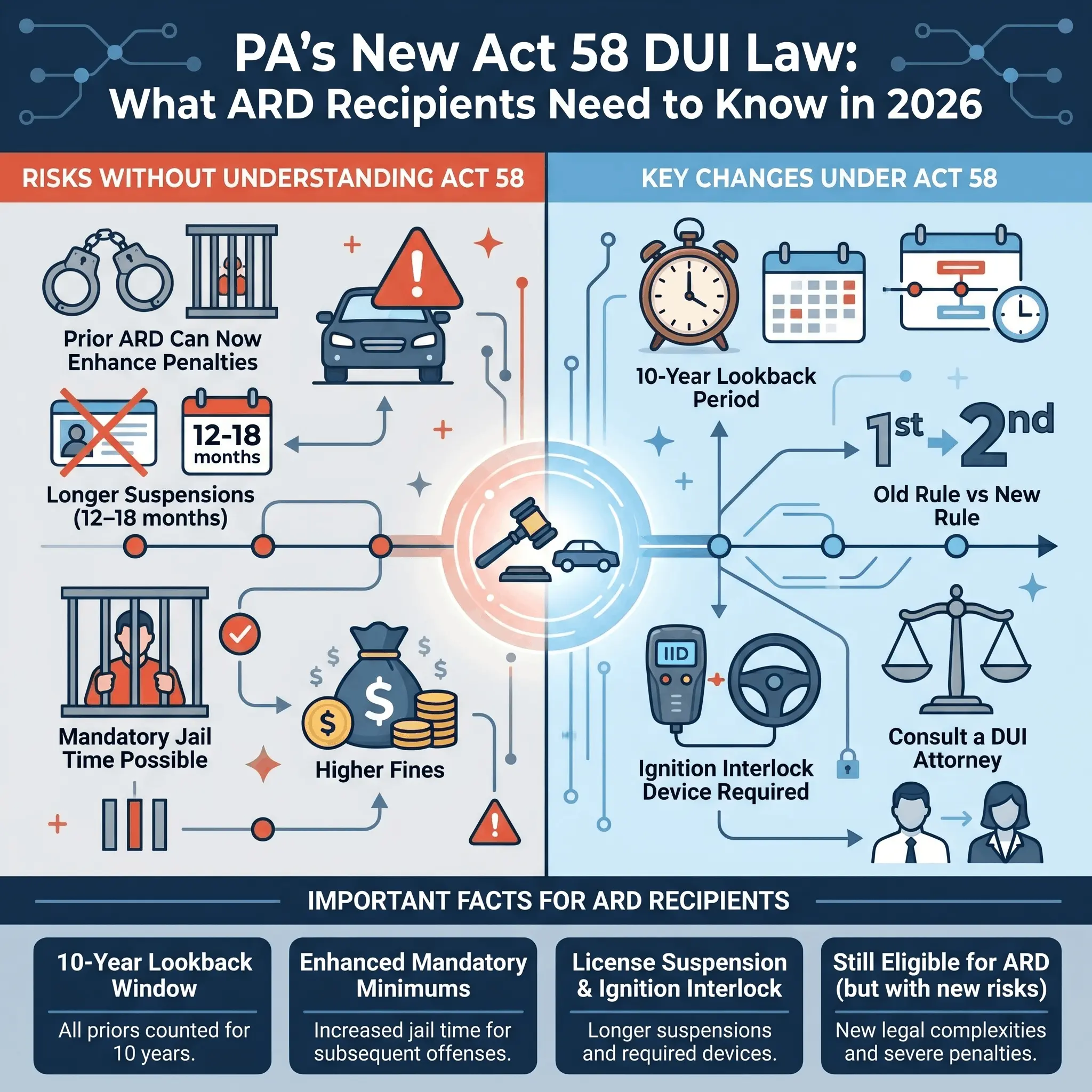
The Old Rule vs. The New Rule: What Changed
The difference between the historical system and the current statutes alters the landscape for drivers with a prior ARD:
- Under the Historical System: Historically, prior ARD participation could not always be used in the same manner as a formal DUI conviction for sentence enhancement purposes. In many situations, an individual facing a new DUI might not face the severe mandatory minimums associated with a second offense.
- Under the Act 58 Provisions: The law changed how prior ARD participation is considered. Now, prior acceptance into the diversion program may trigger enhanced penalties for future DUI offenses under the revised statutes, significantly altering how a later charge is handled.
When Did Act 58 Take Effect
The changes implemented by Act 58 went into effect on December 22, 2025, fundamentally altering the advice attorneys give to clients regarding pretrial diversion and future offenses. The exact timing of the law immediately became a critical factor for litigation and appellate interpretation, particularly concerning how prior ARD participation impacts individuals facing new charges today.
Understanding the ARD Program in Pennsylvania
To grasp the impact of Act 58, it is helpful to understand the purpose and mechanics of the program. This option is a pre-trial intervention program designed for eligible, non-violent offenders. Its goal is rehabilitation rather than immediate punishment.
Who Qualifies for ARD
Generally, the diversion program is available, subject to the prosecutor discretion, to individuals who have not been convicted of a prior misdemeanor or felony and who have not previously participated in the program. For DUI cases, eligibility requirements typically include:
- No severe injuries or fatalities: The DUI incident must not have resulted in an accident that injured or killed a third party.
- No minor passengers: At the time of the traffic stop, there cannot have been a passenger under the age of 14 in the vehicle.
- Valid documentation: The driver must generally have possessed a valid driver’s license and proper vehicle insurance at the time of the offense.
What ARD Completion Used to Mean for Future DUI Charges
Before Act 58, a significant long-term benefit of the program was how it affected future sentencing. While completing the program remained on your driving record with PennDOT for a period, its ability to elevate another DUI to a repeat offense level in criminal court was severely restricted by prior appellate rulings. This distinction was crucial, as the jump from first-offense to second-offense DUI penalties in Pennsylvania is substantial.
How Act 58 Redefines “Prior Offense” for DUI Purposes
The core of Act 58 is its redefinition of what may constitute a prior offense under Pennsylvania’s DUI statute (75 Pa.C.S. § 3806).
How Prior ARD Participation May Affect Future DUI Charges
Act 58 amended the law to address acceptance into the program when evaluating a driver’s history. If you face a new DUI charge and have previously completed the program, the court may now treat your current charge with enhanced penalties, provided the incident occurs within the applicable time period.
Crucially, Pennsylvania utilizes a 10-year lookback period. This means the law generally applies to future DUI cases occurring within 10 years of your prior ARD participation or resolution. If your new charge falls within this 10-year window, your previous diversion may significantly affect how your case is treated.
How This Affects Your BAC Level and Penalty Classification
Pennsylvania’s DUI penalties are determined by a tier system based on Blood Alcohol Content (BAC) and the number of recognized prior offenses. If your prior ARD participation is utilized as a prior offense under Act 58, it may push your case into a higher penalty classification. This means you could face:
- Steeper financial fines: You may be subject to significantly higher mandatory fines that can run into the thousands of dollars.
- Extended license suspensions: You may face longer mandatory periods without your driving privileges, often up to 12 or 18 months.
- Harsher mandatory minimum jail sentences: You could face mandatory incarceration time, even if your BAC for the new offense is relatively low.
What Act 58 Means for First-Time DUI Offenders Going Forward
For individuals facing their first DUI charge, Act 58 fundamentally alters the risk-reward calculus of accepting a plea agreement or pretrial diversion. While the program remains a valuable tool to avoid a formal criminal conviction and mandatory jail time for a first offense, its long-term implications must be carefully considered.
Higher Mandatory Minimums for Repeat Offenders
If you go through the diversion process and are later charged with a second DUI within the 10-year lookback period, the potential mandatory minimum penalties escalate rapidly. What might have been a few days of jail time or probation under the historical system may become months of mandatory incarceration under the new rules.
License Suspension and Ignition Interlock Requirements
A new DUI charge that utilizes a previous diversion for enhancement may also trigger much more severe administrative consequences. Depending on the details, you might expect:
- Extended mandatory license suspensions: You may lose your driving privileges for a much longer period, typically ranging from 12 to 18 months.
- Ignition Interlock Device (IID) mandates: You could be required to install and pay for an IID on your vehicle for at least a year before full privileges are restored.
Who Is Most at Risk Under Act 58
The individuals most at risk are those who went through the diversion process within the last decade, assuming that their prior enrollment would not affect them if they made another error in judgment. If you are operating under the outdated assumption that your prior ARD participation cannot be used for sentence enhancement, you could be facing a challenging legal reality if pulled over again.
Common Mistakes to Avoid After Act 58 Took Effect
Navigating a DUI charge is complex, and Act 58 has made it even more treacherous. Common mistakes include:
- Assuming an expunged record is completely hidden: Believing that because your criminal record expungement was granted, it cannot be accessed or used for sentence enhancement in a new DUI proceeding.
- Attempting to represent yourself: Trying to navigate the complexities of Act 58, the 10-year lookback period, and potential constitutional challenges without specialized legal knowledge.
- Underestimating the potential penalties: Failing to realize that another DUI post-diversion may now carry mandatory jail time and extended license suspensions.
- Pleading guilty prematurely: Assuming there is no defense against a new charge before having an attorney review the specific details of the traffic stop and testing procedures.
Steps to Take If You Have Previously Completed ARD
If you have gone through the program in the past, proactive measures are crucial. You should consult with a qualified DUI attorney to understand exactly how Act 58 may impact your specific situation. This is especially important if you are facing a new charge or are simply concerned about the long-term implications of your prior ARD participation within the 10-year window.
How Penglase & Benson Can Help
At Penglase & Benson, we stay at the forefront of Pennsylvania’s evolving DUI laws. Our attorneys have extensive experience navigating complex DUI cases and the nuances of this specific legal option. We can help you understand the implications of Act 58 and develop a strong defense strategy tailored to your unique circumstances.
We will carefully review your history, analyze the specific details of your current charge, and strongly advocate for your rights. Whether negotiating for reduced penalties or challenging the application of Act 58 in court, we are committed to achieving the best possible outcome for our clients.
Visit our Contact Page to send us a message and schedule your free consultation today.
Frequently Asked Questions
Does Act 58 apply retroactively to past ARD completions?
This has been one of the most litigated aspects of Act 58, particularly in light of complex appellate rulings like Commonwealth v. Shifflett. Pennsylvania courts have continued interpreting how Act 58 applies to previous diversion cases. Appellate interpretation has evolved through recent rulings, and outcomes may depend heavily on the specific facts and procedural history of your case. You should consult an attorney to discuss how the courts in your jurisdiction are currently handling retroactivity issues.
Can I still apply for ARD under Act 58?
Yes, pretrial diversion is still an available and valuable program for eligible first-time offenders. It still allows you to avoid a formal criminal conviction and mandatory jail time for your first offense. However, you must now weigh this against the reality that your prior ARD participation may be used for sentence enhancement if you ever receive another DUI within the statutory lookback period.
What happens if I get a second DUI after completing ARD?
Under the Act 58 provisions, if your new charge occurs within the 10-year lookback period, it may trigger enhanced penalties. You could face significantly harsher mandatory minimum penalties, which typically include potential jail time, steeper fines, and a longer license suspension, based on your BAC level and the application of the previous diversion.
How does Act 58 affect my sentencing tier?
Pennsylvania uses a tiered sentencing system based on BAC and recognized prior offenses. Because Act 58 changed how prior ARD participation is evaluated, a new DUI may move you into a higher penalty category, which can drastically increase the mandatory minimums you might face.
Will my ARD still be expunged under Act 58?
Yes, successful completion of the diversion program still allows you to petition for the expungement of your criminal record for that specific incident. However, while the public criminal record may be expunged, prior ARD participation may remain available to courts and PennDOT for limited statutory purposes related to future DUI proceedings and sentence enhancement considerations.

