
The SBA EIDL loan that saved your business in 2020 is likely suffocating it in 2026. With Treasury collections ramping up and SBA hardship options becoming increasingly limited, you need to know exactly what comes next if you have stopped making payments and are staring at threatening letters.
An EIDL default is a direct threat to your personal livelihood. Unlike private banks, the federal government possesses extraordinary collection powers. They do not need to take you to court to seize your tax refunds or immediately garnish up to 15% of your paycheck. Furthermore, the Department of Justice can eventually secure judgments to place restrictive liens on your family home, paralyzing your ability to sell or refinance.
Ignoring the problem will only accelerate these collection tactics and add a devastating 30% collection fee to your balance immediately upon transfer. You need a clear, actionable plan to protect your home and income before the Treasury takes the next step.
What Is an SBA EIDL Loan
To understand the consequences of defaulting, it is helpful to clearly define the debt you are dealing with. The Economic Injury Disaster Loan (EIDL) program is a federal loan initiative administered by the SBA.
While the program has existed for years for localized natural disasters, it was massively expanded during COVID-19. For for-profit businesses, these loans typically carried a fixed 3.75% interest rate over a 30-year term.
However, your legal exposure depends entirely on how much money you borrowed. Here is a breakdown of the loan tiers and their requirements:
| Loan Amount | Collateral Required (UCC-1 Lien) | Personal Guarantee Required | Risk Level |
| Under $25,000 | No | No | Low (Unsecured) |
| $25,000 – $200,000 | Yes (Business Assets) | No | Medium (Business at risk) |
| Over $200,000 | Yes (Business Assets) | Yes | High (Personal assets at risk) |
Because the federal government is the lender, an SBA EIDL is not like a standard private bank loan. The government has far-reaching, specialized powers to collect federal debts, making default a highly serious legal matter.
What Does “Default” Actually Mean
In the context of an SBA EIDL, “default” is a specific legal status that triggers a cascade of collection actions. It does not happen the moment you miss a single payment.
The timeline moves quickly once you fall behind. Here is the typical progression:
- Delinquency: Your account becomes delinquent the moment you miss your first payment. The SBA will begin sending warning demand letters and emails.
- Loan Acceleration: If the delinquency is not resolved, the SBA will dissolve your 30-year payment plan. The entire remaining principal balance and all interest become due immediately in one lump sum.
- Treasury Transfer: Typically, after 120 days of delinquency, the loan transfers to the U.S. Department of the Treasury’s Offset Program (TOP) and Cross-Servicing program.
This transfer to the Treasury is the critical turning point where your problem escalates into a severe threat to your personal and financial security.
Immediate Consequences When You Stop Paying
The moment you stop paying your EIDL and the loan accelerates into default, the financial penalties compound rapidly. You will immediately face:
- Rapid Interest Accumulation: Because these are 30-year loans, the interest alone can add thousands of dollars to your balance.
- Massive Treasury Fees: The Treasury Department adds an approximately 30% collection fee to your total outstanding loan balance immediately upon transfer. A $100,000 loan can jump to $130,000 instantly.
- Collection Letters: You will receive high-pressure notices with tight deadlines (often 60 days) to resolve the debt before forced collections begin.
- Private Debt Collectors: The government often contracts private debt collection agencies to pursue you.
It is during this immediate aftermath that many small business owners panic. This is precisely the time when you need to seek qualified legal help from EIDL attorneys.
Long-Term Impacts of EIDL Default
If the immediate consequences are ignored, the U.S. Treasury will deploy its vast arsenal of long-term collection tools. Because this is federal debt, the government does not always need to take you to court.
Damage to Your Credit Score
A default on an SBA disaster loan will severely damage your credit. If you operate as a sole proprietor or signed a personal guarantee, the Treasury will report the debt directly to major consumer credit bureaus (Experian, TransUnion, Equifax).
Your score can plummet by 100 points or more overnight. A ruined personal credit score will prevent you from getting a mortgage, financing a car, or securing future funding.
Federal Tax Refund and Benefit Offsets
Through the Treasury Offset Program (TOP), the government can simply intercept money it already owes you. Targets include:
- Your annual federal income tax refund (they will take the entire amount).
- Up to 15% of your Social Security benefits (though the first $750 per month is generally protected from non-tax federal debt offsets).
- Federal military pensions.
- Other federal payments you are entitled to receive.
Liens on Property
If your loan was over $25,000, you granted the SBA a UCC-1 blanket lien. In a default scenario, the government can technically seize your business inventory, machinery, and equipment.
Worse, if you signed a personal guarantee, the Department of Justice can eventually seek a judgment and place a lien on your personal real estate, including your family home. You will not be able to sell or refinance your house until the lien is satisfied.
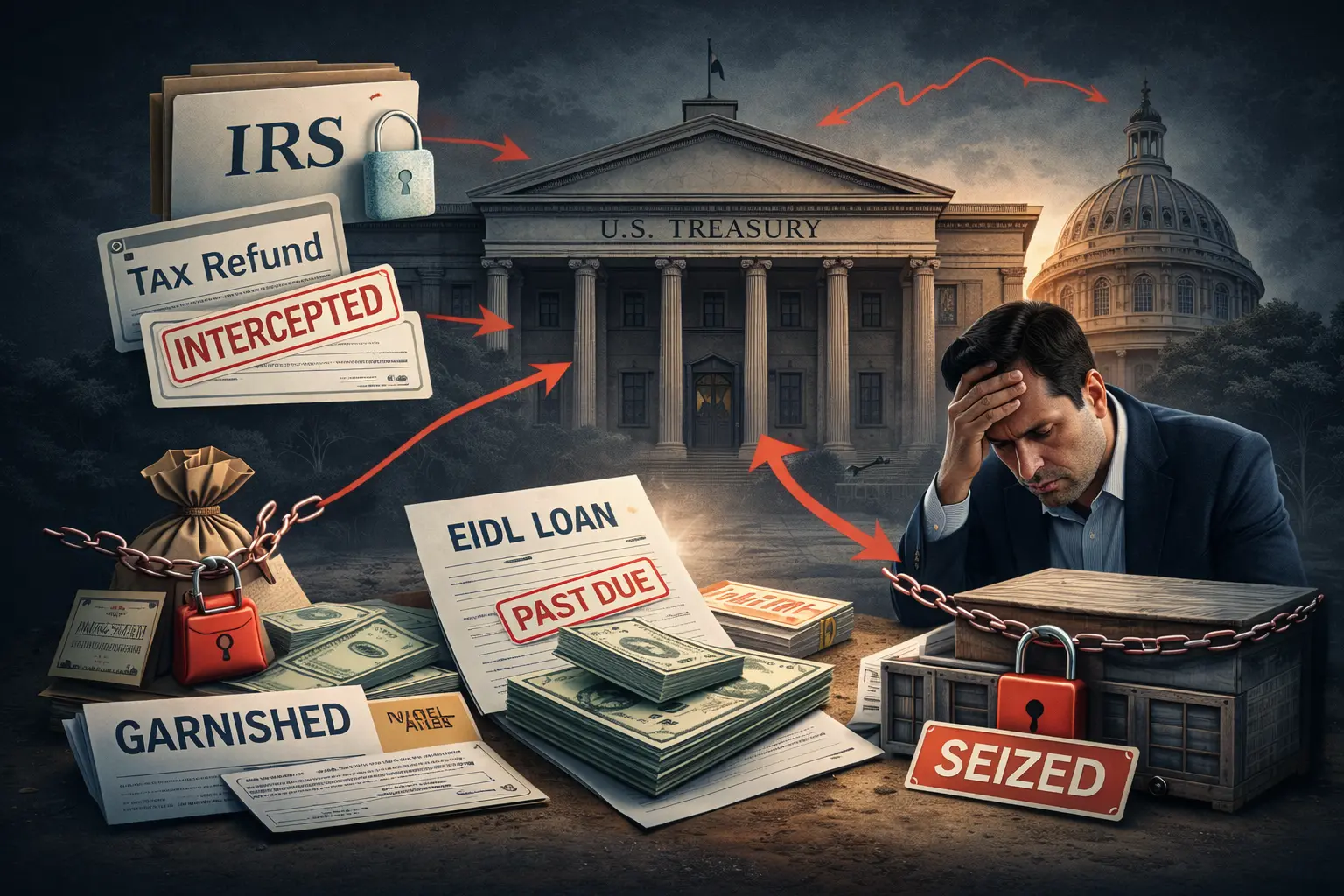
Can the U.S. Treasury Garnish Your Wages
Yes, absolutely. This is one of the most frightening realities of an EIDL loan default.
If you transition from running your business to taking a W-2 job as an employee, the federal government uses a mechanism called Administrative Wage Garnishment (AWG). Here is what makes AWG so dangerous:
- No Court Order Needed: Unlike private credit card companies, the Treasury does not need to sue you first.
- High Deduction Rate: The law compels your employer to deduct up to 15% of your disposable pay from every single paycheck.
- Employer Notification: Your HR department will immediately become aware of your massive defaulted government debt, which can be highly embarrassing.
- Tight Deadlines: If you receive a Notice of Intent to Initiate AWG, you usually have only 30 days to request a hearing and prove financial hardship.
Can You Eliminate EIDL Debt in Bankruptcy
Yes. There is a widespread myth that because the EIDL is a federal loan, it is immune to bankruptcy. This is false.
SBA loans are generally considered standard unsecured debt in a personal bankruptcy (for the portion not covered by collateral). They are treated similarly to credit card debt or medical bills.
Here is a quick overview of how different bankruptcy chapters handle EIDL debt:
| Bankruptcy Chapter | Best Suited For | Impact on EIDL Debt |
| Chapter 7 (Liquidation) | Failed businesses, individuals with overwhelming debt | Can completely wipe out your personal liability for the loan. |
| Chapter 13 (Reorganization) | Individuals with regular income protecting assets (like a home) | Restructures debt; the remaining EIDL balance is entirely forgiven after a 3 to 5-year payment plan. |
| Chapter 11 (Subchapter V) | Operating small businesses, trying to stay open | Restructures debts to improve cash flow, potentially reducing the EIDL principal to collateral value. |
Options to Resolve or Settle Your EIDL Loan
If bankruptcy is not the right fit for you, there are still other legal avenues to explore. Resolving an EIDL loan default requires careful negotiation, and here are the primary paths we can pursue:
Settlement for Less Than Owed
Can you settle an SBA loan for less than the full balance? Yes, but it is incredibly difficult to do on your own.
- The Strategy: Negotiate a lump-sum settlement with the U.S. Treasury.
- The Requirement: You must definitively prove severe financial destitution to show you cannot pay the full amount. Settlements at the Treasury level are often limited to ~20% discounts on the inflated balance (after the 30% fee is added), and require strong proof of hardship.
- How We Help: We work with you to compile the extensive financial disclosures required to convince the Treasury that accepting a reduced amount is their best option, although significant discounts are difficult to obtain and never guaranteed.
Forbearance & New Payment Plans
If your business is still operating and has cash flow, but you just cannot afford the fully amortized monthly payment, we can seek a structured plan.
- The Strategy: Explore limited remaining relief options, such as one-time reduced payments (50% for 6 months if eligible via the SBA portal) or structured installment agreements with the Treasury.
- The Goal: Secure a monthly payment you can actually afford while immediately stopping the threat of wage garnishment.
- How We Help: We use precise legal maneuvering to negotiate affordable terms directly with the government on your behalf.
Offer in Compromise (OIC)
The SBA’s Offer in Compromise is extremely limited for COVID EIDL loans in 2026 and is rarely approved without full business closure and liquidation. Furthermore, post-Treasury transfer, options narrow even further.
- The Requirement: The SBA will generally only consider an OIC if your business has permanently closed, all business assets are fully liquidated, and you cannot repay.
- The Strategy: Prove to the government that your offer represents the maximum possible recovery they will ever get.
- How We Help: If you meet these incredibly strict criteria, our firm will build and submit a compelling, evidence-backed OIC package to try to resolve the debt once and for all.
Steps You Should Take Right Now If You’re in Default
If you are facing an EIDL loan default, panic is your worst enemy. Here are the immediate steps you should take:
- Do Not Ignore the Letters: Throwing Treasury notices in the trash will only accelerate wage garnishments and tax offsets.
- Review Your Loan Documents: Look at your loan authorization. Did you sign a personal guarantee? Is there a UCC lien? Know your exposure.
- Assess Business Viability: Take an objective look at your business. Can it survive, or is it effectively dead and accumulating more liabilities?
- Keep Funds Separate: Commingling funds is a red flag. Ensure all EIDL funds were used purely for authorized business expenses to avoid fraud investigations.
- Do Not Transfer Assets: Do not suddenly transfer your house to your spouse or sell equipment for one dollar. The government views this as “fraudulent conveyance.”
- Gather Financial Documents: Organize your last three years of tax returns, profit and loss statements, and bank statements.
- Consult an Attorney: You are fighting the federal government. Reach out to a law firm that handles SBA default and federal debt negotiation.
- Contact the Treasury: Contact the Treasury directly if already transferred (but preferably through counsel) to prevent an immediate acceleration of collection actions while a resolution is negotiated.
How Penglase & Benson Can Help
At Penglase & Benson, we understand the immense stress you are under. You did not start your business with the intention of defaulting on a federal loan.
Our attorneys are dedicated to helping small business owners navigate complex federal debt problems. We focus on finding the right strategy for your situation, without judgment.
When you hire our firm, we step between you and the U.S. Treasury. Here is what we do for you:
- Handle all communications and phone calls from collectors.
- Scrutinize the government’s collection attempts for legal violations.
- Halt immediate collection actions, including threats of wage garnishment.
- Build a comprehensive roadmap to resolve your debt via settlement, payment plans, or bankruptcy.
Facing an EIDL loan default is frightening. However, living in fear guarantees the worst possible outcome. You have fundamental legal rights and options. You simply need to take the first step and ask for legal help.
Don’t let the U.S. Treasury dictate your financial future. If you are struggling with an SBA EIDL loan default, wage garnishment, or overwhelming business debt, Penglase & Benson is here to protect you.
Visit our Contact Page to send us a message and schedule your free consultation today.
Frequently Asked Questions
Can I lose my house because of an EIDL default?
If you took out a loan over $200,000 and signed a personal guarantee, your home is at risk. The U.S. Treasury or the DOJ can secure a judgment and place a lien on your real estate. While the government rarely forecloses on primary residences, the lien will prevent you from selling or refinancing. Bankruptcy or settlement can protect your home.
How long until the Treasury starts garnishing my wages?
Once your loan defaults, the Treasury will send a Notice of Intent to Initiate Administrative Wage Garnishment. You usually have 30 days to request a hearing. If you ignore the letter, wage garnishment (up to 15% of your income) can begin within a few weeks.
Will defaulting on my EIDL loan affect my personal credit or only business credit?
If your loan was under $200,000 and your business is an LLC/Corporation, it primarily impacts business credit. However, if you are a sole proprietor or signed a personal guarantee, the default will be reported to consumer credit bureaus, severely damaging your personal score.
Can I negotiate a settlement for much less than I owe?
It is possible, but complex. The Treasury will not accept a lowball settlement just because you ask. You must provide extensive financial documentation proving you are completely incapable of paying the full amount.
Does filing for bankruptcy really eliminate SBA EIDL debt?
Yes. An SBA EIDL loan is treated as general unsecured debt in personal bankruptcy (for the portion exceeding any collateral value). Chapter 7 can wipe out personal liability, while Chapter 13 allows you to discharge the remaining balance after a payment plan.
What happens if I ignore the Treasury letters?
The government will automatically proceed with taking your tax refunds, levying bank accounts, and ordering your employer to garnish your wages. They will also add a 30% collection fee to your balance.
Is there still time to fix this in 2026?
Yes. Even if your loan is already in default or wage garnishment has been threatened, a qualified attorney can often halt immediate collections while negotiating a resolution or preparing a bankruptcy petition.
Has automatic credit reporting started for EIDL defaults in 2026?
Yes, the Treasury reports defaulted EIDL debt to major credit bureaus. While the SBA initially delayed mass reporting for smaller COVID EIDL loans, broader automatic credit reporting has been ramping up throughout 2026 as enforcement intensifies.

