
Seeing flashing police lights in your rearview mirror is a highly stressful experience, but hearing an officer tell you that you are under arrest changes your life in an instant. A single mistake or a momentary lapse in judgment can suddenly plunge you into the frightening complexities of the criminal justice system. If you have recently been charged with a DUI in Pennsylvania, the panic and uncertainty you are feeling about your future are completely understandable.
The days immediately following a DUI in Pennsylvania are often the most critical for your legal defense. The decisions you make right now can dictate whether you lose your driving privileges, face steep financial penalties, or potentially spend time behind bars. Unfortunately, the state does not give you time to catch your breath, as administrative deadlines and court dates are triggered the moment you are processed and released from custody.
Fighting these charges is not something you should attempt on your own, but understanding the legal road ahead is your first step toward protecting your freedom. Let’s break down exactly what happens after an arrest, how the state classifies these offenses, and the strategic actions you must take immediately to safeguard your rights, your career, and your future.
What Happens the Moment You Are Arrested for DUI in Pennsylvania
The progression of a DUI case follows strict procedural rules. Understanding how the police gather evidence against you is crucial for your defense strategy.
The Traffic Stop and Field Sobriety Tests
A DUI investigation typically begins with a traffic stop based on reasonable suspicion of a traffic violation, or at a designated DUI checkpoint. If the officer suspects intoxication, they will generally ask you to step out of the vehicle to perform Field Sobriety Tests (FSTs).
- Purpose of FSTs: Tests like the walk-and-turn or one-leg stand are used by officers to establish probable cause for an arrest.
- Your right to decline: In many situations, drivers may decline pre-arrest field sobriety tests, although officers may still consider the refusal along with other observations when determining whether probable cause exists for an arrest. These tests are highly subjective, and environmental factors such as uneven pavement, weather conditions, fatigue, age, injuries, or medical conditions may affect performance.
Chemical Testing and Implied Consent Law
Once you are formally arrested for a DUI in Pennsylvania, the legal landscape changes significantly due to the state’s “Implied Consent” law.
- The Implied Consent requirement: By driving on Pennsylvania roads, you legally consent to chemical testing (blood or breath) if you are arrested for suspected drunk driving.
- The cost of refusal: If you refuse this post-arrest chemical testing, PennDOT will generally impose a separate administrative suspension of your driver’s license – typically ranging from 12 to 18 months – even if the underlying DUI charge is later reduced, dismissed, or resolved separately from the criminal proceedings. Furthermore, your refusal can often be used as evidence against you in court.
Understanding Pennsylvania’s DUI Laws and BAC Limits
Pennsylvania utilizes a tiered system to classify DUI offenses, which means the severity of your potential penalties is heavily dictated by your Blood Alcohol Content (BAC) at the time of testing.
The state generally categorizes a DUI in Pennsylvania into three primary tiers:
- General Impairment (BAC 0.08% to 0.099%): The lowest penalty tier, though it still carries significant consequences.
- High BAC (BAC 0.10% to 0.159%): The middle tier, which triggers harsher minimum penalties and longer potential suspensions.
- Highest BAC (BAC 0.16% and higher): The most severe tier. Drivers accused of operating a vehicle under the influence of controlled substances, as well as individuals who refuse chemical testing after a lawful DUI arrest, may face enhanced penalties under Pennsylvania DUI laws that can be comparable to those imposed in the Highest BAC tier.
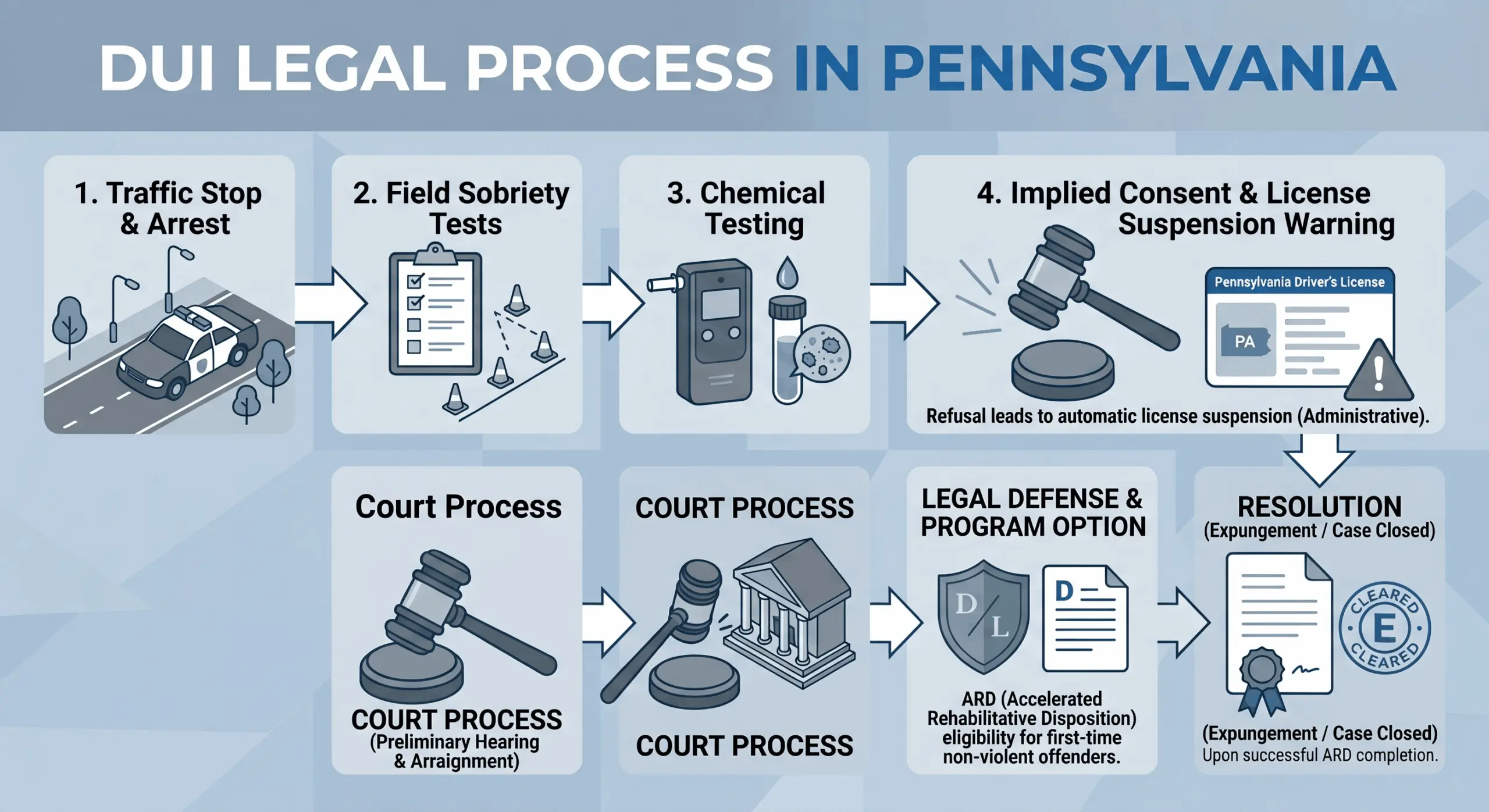
The Pennsylvania DUI Court Process Step by Step
Navigating a DUI in Pennsylvania means moving through several distinct phases of the criminal justice system. Your attorney will guide you through each critical appearance.
Arraignment and Preliminary Hearing
After your arrest and processing, you will receive a summons in the mail or be scheduled for your first court appearance.
- Preliminary Arraignment: A judge formally reads the charges against you and sets your bail conditions.
- Preliminary Hearing: This is a crucial early step. The Magisterial District Judge does not decide guilt or innocence here; rather, they determine if the prosecution has enough basic evidence (a prima facie case) to forward your charges to the Court of Common Pleas.
Pre-Trial Motions and Plea Negotiations
If your case moves forward, your defense attorney begins thoroughly analyzing the evidence.
- Discovery phase: Your lawyer will request all police reports, dashcam footage, and blood lab results from the District Attorney.
- Suppression motions: If the police lacked probable cause to stop your vehicle, or if the blood testing procedures were flawed, your attorney may file motions to suppress the evidence, which can sometimes lead to charges being reduced or dismissed.
DUI Penalties in Pennsylvania: What You Are Facing
A conviction for a DUI in Pennsylvania carries severe, mandatory penalties that escalate based on your BAC tier and whether you have prior offenses within the statutory lookback period. Depending on the specific details of your case, you may face:
- Incarceration: Mandatory minimum jail or prison sentences ranging from a few days to several years.
- Financial fines: Steep court fines that can easily reach into the thousands of dollars.
- License suspension: Mandatory loss of your driving privileges.
- Ignition Interlock Device: You may be required to install and pay for a breathalyzer device in your vehicle once your driving privileges are conditionally restored.
- Probation and treatment: Mandatory substance abuse evaluations, court-ordered treatment programs, and highway safety classes.
Should You Accept ARD After a DUI Arrest in Pennsylvania
For eligible first-time offenders, the Accelerated Rehabilitative Disposition (ARD) program is a highly valuable pretrial diversion option.
- The benefits: If accepted into ARD, you are generally not required to plead guilty. Upon successful completion of the program’s requirements (like probation, community service, and classes), your criminal charges are dismissed, and you may petition to have the arrest record expunged.
- The long-term consideration: It is important to note that under recent changes to Pennsylvania law (Act 58), prior ARD participation may be treated as a prior offense for sentence enhancement purposes if you face a subsequent DUI charge within the 10-year lookback period. You should carefully review your ARD eligibility and long-term implications with an attorney.
How a DUI Arrest Affects Your Driving Privileges
It is a common misconception that your license is only suspended if you are found guilty in criminal court. In reality, dealing with a DUI in Pennsylvania involves fighting a two-front war: one in criminal court, and one with the Pennsylvania Department of Transportation (PennDOT).
PennDOT operates independently of the criminal proceedings. You may face a license suspension for refusing a breathalyzer (a civil penalty) even if your criminal DUI charges are eventually dropped. Managing PennDOT appeals and understanding your eligibility for an Occupational Limited License (OLL) requires strategic legal maneuvering.
Common Mistakes People Make After a DUI Arrest
Panic often causes individuals to make critical errors that severely damage their legal defense. If you have been arrested, you should generally avoid these common pitfalls:
- Speaking to the police without a lawyer: Trying to “explain your way out of it” usually provides prosecutors with statements they can use against you.
- Pleading guilty immediately: Assuming the case is unbeatable and pleading guilty before fully evaluating the evidence may significantly limit available defense strategies and expose you to serious criminal, financial, and licensing consequences.
- Driving on a suspended license: If PennDOT suspends your license, driving anyway can trigger mandatory jail time.
- Discussing the case online: Posting about your arrest or the details of your evening on social media provides investigators with a public record of your actions.
Steps to Take Immediately After a DUI Arrest in Pennsylvania
To safeguard your freedom and begin building a strong defense, you should take the following steps the moment you are released from custody:
- Write everything down: Document every detail of your traffic stop, what the officer said, what you consumed, and how the testing was administered while your memory is fresh.
- Gather your documents: Collect your citation, bail papers, and any vehicle towing receipts.
- Exercise your right to remain silent: Do not discuss the details of your case with anyone other than your attorney.
- Hire legal counsel immediately: Retain a qualified defense attorney as early in the process as possible to ensure no critical deadlines for evidence preservation or PennDOT appeals are missed.
How Penglase & Benson Can Help
At Penglase & Benson, we understand the overwhelming stress of facing criminal charges. A DUI arrest does not mean a conviction is inevitable. You have fundamental legal rights, and you deserve a defense strategy tailored to the unique facts of your case.
Our attorneys focus on scrutinizing every element of a DUI in Pennsylvania. We will carefully review the traffic stop for constitutional violations, analyze the chemical testing procedures for accuracy, and work strategically to protect your driving privileges. Whether negotiating for your entry into the ARD program, seeking a reduction in charges, or fighting for an acquittal in court, we represent you vigorously at every step.
Visit our Contact Page to send us a message and schedule your free consultation today.
Frequently Asked Questions
Do I have to tell my employer about my DUI arrest?
Generally, you are not legally required to inform your employer about a mere arrest unless your specific employment contract, employee handbook, or licensing board mandates disclosure. However, if your job requires a commercial driver’s license (CDL) or driving a company vehicle, a license suspension will likely impact your employment status.
Can a DUI in Pennsylvania be dismissed if the police didn’t read me my Miranda rights?
Not necessarily. Miranda rights are typically only required before police conduct a “custodial interrogation.” If you were not questioned after being placed in police custody, the failure to read your rights may not automatically result in a dismissal. However, any incriminating statements you made during custody without being Mirandized may be suppressed and excluded from evidence.
Will I definitely go to jail for a first-time DUI?
No, jail time is not an absolute certainty for a first offense. Many first-time offenders with no prior criminal record may be eligible for pretrial diversion programs like ARD, which generally allow you to serve a period of probation and avoid jail time entirely upon successful completion.
Can I refuse a breathalyzer test in PA?
You can generally refuse a pre-arrest portable breath test (PBT) on the side of the road without severe administrative penalties. However, if you are lawfully arrested for a DUI and refuse the post-arrest official evidentiary breath or blood test, you will typically face a mandatory, automatic license suspension under Pennsylvania’s Implied Consent law.
How long does a DUI stay on my driving record?
A standard DUI conviction will generally remain on your permanent criminal record. However, if you successfully complete the ARD program, your criminal record for the arrest may often be expunged. Despite expungement, PennDOT and the courts may still retain records of your ARD participation for 10 years to determine sentencing enhancements if you receive another DUI.

