
Following his victory at the Second Battle of Bull Run (Manassas), Robert E. Lee made the decision in August of 1862 to invade the North. This decision, motivated in part to relieve the pressure on Virginia, which had hosted almost 2 years of war, and to influence the upcoming northern elections, would lead the Army of Northern Virginia on its first offensive of the war.
Crossing the Potomac
On September 4, 1862 Confederate forces began crossing the Potomac River at White’s Ford just northeast of Leesburg, Virginia. They would then begin rallying at Frederick, Maryland. 14,000 Union soldiers were garrisoned nearby at Harper’s Ferry and Martinsburg, Virginia (West Virginia). The Confederate movement would interdict Confederate forces between these Union troops and Washington DC, effectively cutting them off from communication and support. Lee had expected these forces to therefore withdraw upon his approach. They did not. Thus, forcing Lee to have to deal with them before he could continue north. Lee could not afford a force this side to lie so close to his line of supply and communication.
Colonel Dixon Miles, Defender of Harper’s Ferry
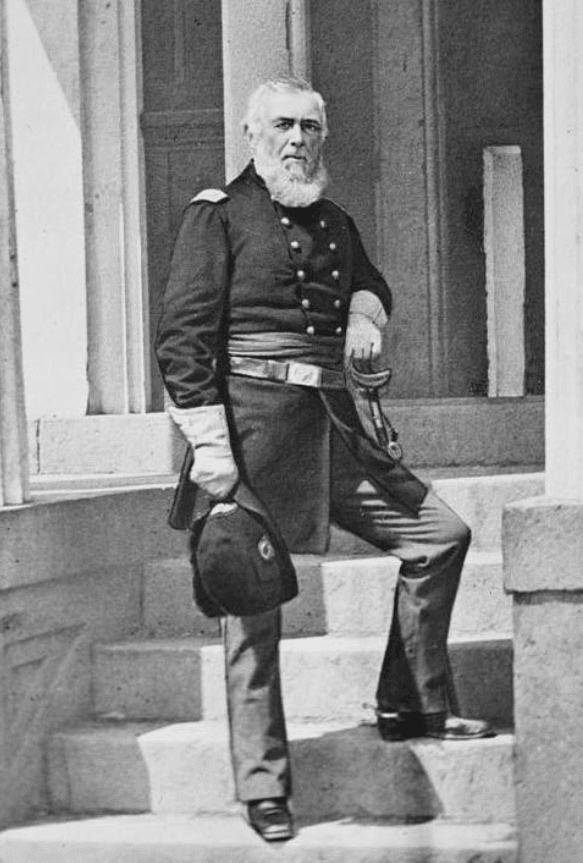
Colonel Dixon Stansbury Miles commanded Harper’s Ferry. The 59-year-old colonel had served in the military for 42 years, having entered West Point at the age of 15. He had outranked Robert E. Lee in the antebellum army. His reputation had been tarnished at the First Battle of Bull Run when he had been accused of drunkenness while commanding the Union’s reserve Division. He was ultimately cleared of the charges but had something to prove.
A Command Post, Not an Armory
By this time in the war, Harper’s Ferry represented a command post and not an armory. Both the large and small Arsenals had been burned by Union troops in April 1861 to prevent their supply of arms from falling in the hands of Confederate forces. Confederate forces under the command of Thomas J. (Stonewall) Jackson and at the direction of Robert E. Lee and the Confederate Congress dismantled the armory machinery and had it shipped further south for use and protection in the spring of 1861. Joseph Johnston, prior to his departure for Bull Run directed that the armory buildings themselves, and the great covered bridge linking Harper’s Ferry to Maryland, be burned in June of 1861.
The “Railroad Brigade”
Believing Dixon Miles to be a good soldier, George B. McClellan had ordered Miles to protect all of the rail lines between Baltimore and Washington; Harper’s Ferry and Baltimore; Harper’s Ferry west to the South Branch of the Potomac; and Harper’s Ferry south to Winchester. This equated to 380 miles of territory. For his headquarters, Dixon chose Harper’s Ferry. His command was nicknamed the “Railroad Brigade.” Before the telegraph lines had been cut, Miles had been ordered to defend Harper’s Ferry at all costs.
Lee’s Audacious Plan
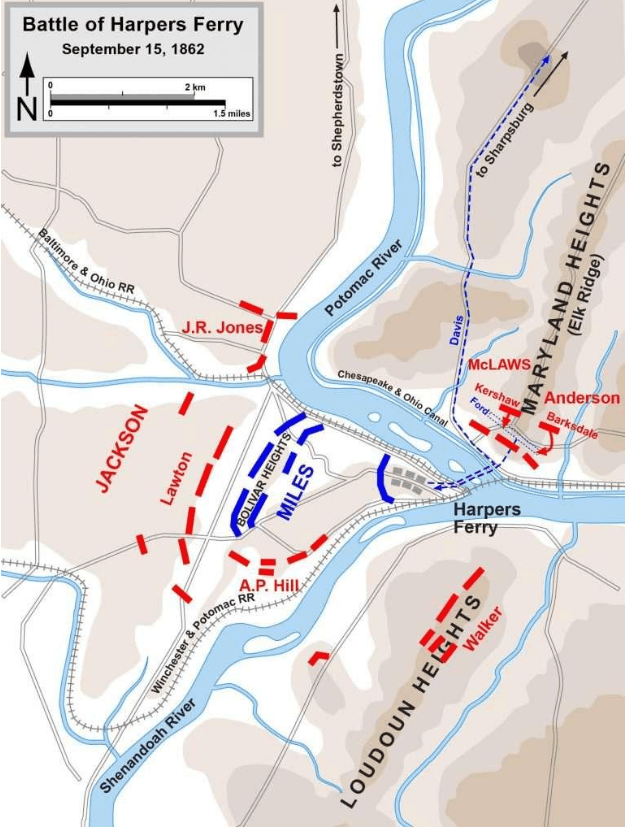
Robert E. Lee had to capture Harper’s Ferry before he could continue north. Given his familiarity with Harper’s Ferry having previously commanded Confederate forces there, Stonewall Jackson was chosen for the task. The plan was audacious and flew in the face of established tactics. Lee would divide his forces, sending two-thirds of his Army with Jackson and the remaining third under the command of James Longstreet north towards Hagerstown, where they would reunite with Jackson near Boonsboro and continue north.
Three Columns to Encircle the Ferry
Dividing his forces was one thing. But Lee’s plan called for dividing his forces further. To capture Harper’s Ferry, Jackson would divide his assigned divisions into three columns. Forces under the command of General John G. Walker would recross the Potomac and capture Loudoun Heights, sealing in Harper’s Ferry from the south and east. Forces under the command of Lafayette McLaws would capture Maryland Heights, sealing off Harper’s Ferry from the north. Stonewall Jackson would recross the Potomac from the north, capture Martinsburg before turning east and capturing Bolivar Heights, sealing off Harper’s Ferry from the west. This plan was detailed to Lee’s commanders in Special Order 191 on September 9, 1862. The next day, the forces divided to accomplish their mission.
Miles Prepares His Defense
Colonel Miles, seeing the approach of the Confederates, prepared to follow his orders and defend Harper’s Ferry. He took a brigade of 2,000 men and sent them to protect Maryland Heights and a naval battery established 900 yards below its summit. Loudoun Heights, being lower than Maryland Height,s was deemed indefensible and thus left unattended. Miles placed another brigade on Camp Hill, just below Bolivar Heights, to protect his entrenched artillery.
Closing the Ring
On September 12th, Brigadier Julius White evacuated his 2,500 soldiers from Martinsburg and entered the protective confines of Harper’s Ferry. On September 13th, after fighting a brief engagement with McLaws, Union forces surrendered the summit of Maryland Heights to McLaw,s thus accomplishing the first part of Lee’s plan. Having evacuated Martinsburg, Stonewall Jackson quickly swung east and gained command of School House Ridge, just above Bolivar Heights, on September 13. Walker had his cannon in place on Loudoun Heights on September 14, thus completing the encirclement of Harper’s Ferry.
The Bombardment Begins
Walker began cannonading the Ferry at about 2:00 p.m., September 14th. Due to their superior elevation on Loudoun and Maryland Heights, Union artillerists could do little to fight back. Students of the battle mistakenly think that Miles and his command rode out the siege in the Ferry itself. They did not. The 11,000-man garrison sought shelter in the long and narrow ravines of Bolivar Heights just above and outside of the Ferry. This protected them from the artillery raining down from above.
Infantry, Not Artillery
The second myth of the battle for Harper’s Ferry is that the garrison surrendered due to being surrounded and the cannonade. Miles’ command was safely sheltered in the Bolivar Heights ravines. Stonewall Jackson was already behind the schedule set forth in Special Order 191. The Order had called for the investment in the Ferry by September 12th. Stonewall Jackson was not only aware that he was behind schedule but that Union forces would be closing in from the east. Time was not on his side. He would need to capture the Ferry sooner rather than later and still have time to race north to join Lee at Boonsboro. Realizing that the Union position on Bolivar Heights could not be captured by artillery alone, Stonewall Jackson ordered A.P. Hill’s Division to flank the Union forces sheltered in the Bolivar Heights ravines. Harper’s Ferry would fall due to the infantry and not the artillery.
A.P. Hill’s Flanking March
On the afternoon of September 14, A.P. Hill moved his division to the right, using School House Ridge as cover and the artillery as a distraction. Following the Shenandoah River on his right, Hill was able to position his infantry and artillery approximately 1,000 yards from the exposed federal left flank. Hill would write, “The fate of Harper’s Ferry was sealed.”
The Surrender
The Confederate bombardment recommenced on the morning of September 15. Around 8:00 a.m., Miles received word that his long-range artillery had been exhausted. With Hill’s infantry on his flank and surrounded with no ammunition to help him fight his way out, Miles concluded to surrender. White flags began to appear. Either not sure of the Union’s intentions or not seeing the white flags, the guns on Loudoun Heights continued firing. A Confederate shell landed close to Miles, ripping the flesh from his calf and causing a mortal wound. Miles would die on the 16th, unable to write any report as to his defense of Harper’s Ferry. Jackson would write to Lee, “Through God’s blessing, Harper’s Ferry and its garrison are to be surrendered.”

