
In the fall of 1862 Harper’s Ferry was a show of its former glory. No longer did it serve as an arsenal and armory. The arsenal had been burned in the spring of 1861 by Union forces seeking to keep the stockpile of weapons out of the hands of approaching confederate forces. The Armory machinery had been removed by subsequent confederate forces and sent south for the making of muskets and rifles to supply the confederacy; the Armory buildings were then burned by confederate forces moving south to participate in the First Battle of Bull Run.
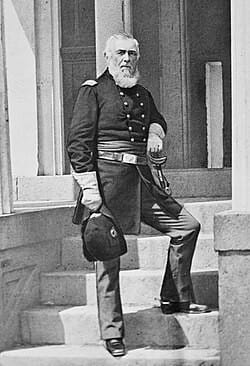
But Harper’s Ferry still posed a threat. Harper’s Ferry was still a transportation hub. The B&O Railroad and Winchester and Potomac Rail Roads went through Harper’s Ferry. The Shenandoah and Potomac Rivers met there. Three pikes radiated out from there. Control of Harper’s Ferry allowed access through the Blue Ridge Mountains and an entry point into the Shenandoah Valley. In September of 1862 Colonel Dixon S. Miles commanded a garrison of 11,000 union soldiers in Harper’s Ferry. As Robert E. Lee marched north through Maryland, towards Pennsylvania, he could not afford the garrison at Harper’s Ferry to lie along his avenue of supply, communications and retreat. He had to capture Harper’s Ferry before he could proceed further.
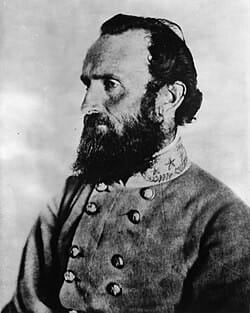
Confederate General Thomas J. “Stonewall” Jackson knew Harper’s Ferry well. He had lived in the region and commanded the Ferry briefly in 1861 when southern troops captured it. He knew it’s weakness; the three heights around the Ferry; Boliver Heights, Loudin Heights and Maryland Heights. The three heights surrounded the town. If you controlled the heights, you controlled the town as you could easily reign artillery down into the town. Of these, Maryland Heights was the key. Maryland Heights was the tallest of the three heights. Control Maryland Heights and you control the other two.
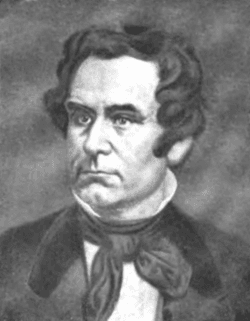
Robert E. Lee divided his forces into four parts. Stonewall Jackson would march his forces from Frederick Maryland to Boonsboro, cross the Potomac at Williamsport and capture Boliver Heights. General John Walker would march south from Frederick Maryland and cross the Potomac at Point of Rocks and capture Loudin Heights from the rear. General Lafayette McLaws would march west from Frederick to Middletown, move south to Burkittsville and ascend Mayland Heights through Solomon’s Gap. The remaining confederate forces under General James Longstreet would march from Frederick to Hagerstown Maryland and await Stonewall Jackson following the capture of Harper’s Ferry.
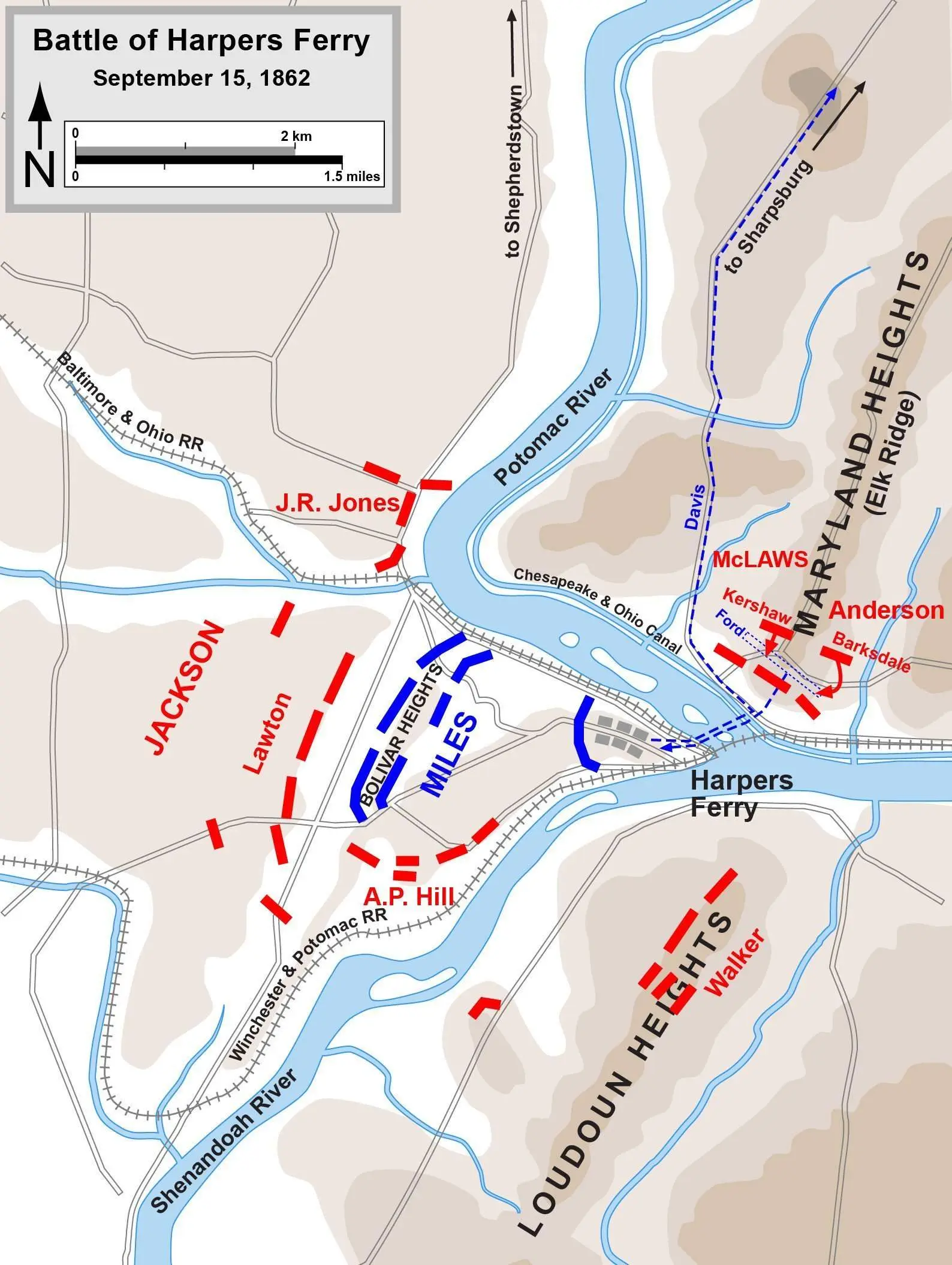
General McLaws occupied Burkittsville on September 11, 1862. Colonel Dixon S. Miles knew the confederates were coming. He had been receiving reports for several days on the confederate approach. He determined that the assault would mirror that used in the Spring of 1862 when Stonewall Jackson, during the Shenandoah Valley campaign nearly captured Harper’s Ferry by approaching from the south to capture Boliver Heights. Miles therefore concentrated his forces on Boliver Heights and sent one of his four brigades, under the command of Colonel Thomas Ford to secure Maryland Heights and use it as an artillery position to defend the town.
On September 12, using an old charcoal road through Soloman’s Gap, McLaws ascended Maryland Heights. The climb was not easy; the terrain was rocky and steep. It was also contested by skirmishers sent by Ford to defend the mountain. Superior numbers won the day for McLaws. Once on Maryland Heights McLaws worked his troops slowly through the woods, brambles and scrub growth one mile south towards the summit of Maryland Heights and Ford’s awaiting brigade. By the morning of September 13, 1862, the stage was set.
Ford commanded approximately 2,000 troops. McLaws had roughly the same numbers. Ford had stretched his brigade, with its back to Harper’s Ferry, across the Maryland Heights. His left flank was anchored by the 126 New York, a fresh, untested regiment. The 126th was commanded by Colonel Eliakim Sherrill. Opposing Ford’s line was the veteran brigade of Brigadier General Joseph Kershaw’s South Carolina Brigade. The forces collided on the morning of September 13th. For several hours the two sides exchanged blows without much movement. To help break the stalemate, McLaws sent Brigadier General William Barksdale and his Mississippians around Ford’s right in an attempt to flank Ford and flush him from his position. Before Barksdale was able to flank Ford, fate stepped in. A confederate bullet found its mark and hit Colonel Sherrill in the jaw. With his tongue badly wounded and his teeth shattered, Sherrill could no longer command the 126th. Confusion quickly overwhelmed the 126th New York. For some unexplained reason, Ford quickly chose to fall back off of Maryland Heights. Upset and confused, Colonel Miles could do nothing more than watch the retreat through his binoculars far below on Boliver Heights. With Ford’s abandonment, McLaws captured Maryland Heights. Throughout September 13 and 14 the confederates would consolidate their position on Loudin and Boliver Heights and seal the door on the Union Garrison at Harper’s Ferry. Colonel Miles, realizing the futility of his position, surrendered on September 15 before being fatally wounded by a confederate shell.
Stonewall Jackson captured Harper’s Ferry on September 13, 1862. It was the largest surrender of U.S. Troops (approximately 12,500) until World War II. Having captured the garrison and its stockpile of weapons and supplies, Stonewall Jackson left a division under the command of General A.P. Hill to finish the surrender and gathering of supplies before marching off to join Robert E. Lee and the confederate forces who were massing north of the town of Sharpsburg Maryland for the battle of Antietam.

