
It usually starts with a simple mistake or a piece of lost mail. You may have moved and never received the notice for your court date. Perhaps you had a family emergency on the morning of your preliminary hearing, and calling the courthouse simply slipped your mind in the chaos.
Now, you have a sinking feeling that a warrant is out for your arrest. You might be terrified to apply for a new job or sign a lease because you are worried about what a background check might reveal. Living with this kind of constant anxiety is stressful.
The good news is that you have options. An active warrant does not automatically mean you are destined to spend weeks in a jail cell. Often, a clear, procedural path exists to resolving the issue if you take proactive steps. This guide will walk you through exactly what a bench warrant is, how the system works, and the steps you can take to clear your name.
What Is a Bench Warrant?
A bench warrant is a specific type of order issued directly by a judge authorizing law enforcement to arrest you and bring you before the court. It gets its name because the judge literally issues it from the “bench” (their seat in the courtroom).
Unlike a traditional warrant, this order is not an accusation that you have committed a brand-new crime. Instead, it is a tool the court uses to enforce its own rules. When you do not comply with a court order, the judge uses this mechanism to force your compliance.
If you have a bench warrant in Pennsylvania, it means the court process has come to a halt because of your absence or inaction. The judge has decided that the only way to get the case moving again is to have law enforcement physically bring you into the courtroom.
Bench Warrant vs. Arrest Warrant: What’s the Difference?
Understanding the bench warrant vs arrest warrant distinction is critical because they originate from completely different circumstances and are handled differently by the legal system.
| Feature | Bench Warrant | Arrest Warrant |
| Reason for Issuance | Violation of a court order or missing a mandatory court appearance. | Probable cause that a specific crime was committed. |
| Who Requests/Issues It | Issued by a judge on their own authority. | Requested by police/detectives after an investigation. |
| Underlying Goal | To force participation in an existing case or matter. | To initiate a brand-new criminal case. |
| How They Are Executed | Often executed during routine traffic stops or unrelated police encounters. | Police actively seek out the individual to make an arrest. |
Why Would a Judge Issue a Bench Warrant?
Judges do not issue these orders randomly; there is always a specific triggering event that causes the court to demand your immediate appearance. In Pennsylvania, under the Rules of Criminal Procedure, a judge must generally have proof that you actually received notice of your obligation before penalizing you for missing it. Here are the most common reasons you might find yourself facing this situation:
- Failure to appear in court: A failure to appear is the most common reason for a warrant, disrupting the judicial schedule, whether you missed a preliminary hearing, a formal arraignment, or a trial.
- Unpaid fines, court costs, or restitution: If you stop making court-ordered payments and ignore subsequent warnings to explain your financial situation, the judge will issue a warrant for a failure-to-pay hearing.
- Probation and parole violations: Missing a check-in, failing a drug screen, or not completing mandatory classes can prompt your officer to report non-compliance.
- Ignoring a subpoena or violating a court order: Witnesses who ignore legally binding subpoenas or individuals who violate family court orders, such as a Protection From Abuse (PFA) order, can be arrested to address the breach.
How Serious Is a Bench Warrant? Consequences You Could Face
You should never ignore an active warrant. Hoping it will go unnoticed is a dangerous strategy that leaves you vulnerable to sudden arrest at the worst possible moments. If you leave the situation unresolved, you could face several severe consequences:
- Sudden Arrest: You can be taken into custody anywhere, at any time, at your home, at your workplace, or in front of your family.
- Contempt of Court: The judge can find you in contempt for ignoring their orders. In Pennsylvania, this can result in up to six months in jail and additional fines.
- Bail Revocation or Increases: If you were out on bail, the judge will likely revoke it. Pennsylvania often allows defendants to post just 10% of their total bail amount; if you skip court, the judge can revoke that privilege and demand the full 100%.
- New Criminal Charges: Under Pennsylvania law, missing court is generally graded as a second-degree misdemeanor called “default in required appearance.” It only becomes a felony if your missed appearance was for a felony charge and you actively fled or hid to avoid apprehension or trial.
- Driver’s License Suspension: For certain offenses, the court will notify PennDOT of your failure to appear, resulting in the suspension of your driving privileges until the warrant is cleared.
- Probation Detainers: If you are on probation, the warrant will likely trigger a detainer, meaning you will be held in jail without the possibility of bail until your violation hearing.
Do Bench Warrants Expire in Pennsylvania?
A very common myth is that if you lie low long enough, the court will eventually drop the issue. So, do bench warrants expire? No, they do not simply fade away with time.
An active warrant will sit on your record indefinitely until one of two things happens: you are arrested, or a judge officially cancels it. You could be pulled over a decade after missing a court date, and that warrant will still show up on the officer’s computer.
There is one narrow exception where a warrant expires by operation of law after an arrest if the court misses a strict 72-hour hearing deadline, but while you are out on the street, the warrant remains active forever.
How to Find Out If You Have a Bench Warrant in Pennsylvania
If you suspect you missed a court date, you need to confirm your status before taking action. Fortunately, court records are largely accessible to the public, meaning you can often look up your own case. Here is how to check if you have a bench warrant safely and accurately.
Searching the Pennsylvania Court Portal (UJS)
The easiest way to check your status is through the Unified Judicial System (UJS) Web Portal. This is the official database for Pennsylvania courts. You can navigate to the UJS portal online and search the docket sheets by your first and last name, your specific case number, or your Offense Tracking Number (OTN). If you select the county where your case is held, you can pull up your case docket; an active warrant will be clearly listed in the docket entries.
A Word of Caution Before You Call the Court or Police
Your first instinct might be to call the local police precinct or walk into the courthouse to ask a clerk about your status. You should avoid doing this in person, as walking into a police station or courthouse with an active warrant legally obligates the officers to arrest you on the spot. It is always safer to check online or have a legal professional verify your status on your behalf.
How to Get a Bench Warrant Lifted Without Going to Jail
While every case is different, there are established legal strategies outlining how to get a bench warrant lifted and how to clear a bench warrant without going to jail.
Filing a Motion to Quash or Recall the Warrant
The most effective strategy is usually having an attorney step in on your behalf. A lawyer can draft and file a formal legal document called a motion to quash (or a motion to recall/lift the warrant). This document asks the judge to cancel the arrest order by explaining why you missed court and assuring compliance moving forward. In some jurisdictions, like the Philadelphia Municipal Court, attorneys can sometimes resolve these issues electronically with the District Attorney’s office.
What It Costs and Whether You’ll Need to Post Bail
People often ask exactly how much it costs to clear a warrant. There is no fixed flat fee, and the financial requirements depend entirely on the judge’s discretion and your original case. If your warrant was for unpaid fines, you will likely need to bring a substantial payment to court.
If it were for a missed hearing, the judge might demand you post bail, though an attorney can argue against increases by highlighting your community ties and proving your absence was a mistake rather than an attempt to flee.
Turning Yourself In – When It’s the Right Move
Sometimes, the court will not accept a written motion, and the only way to clear the warrant is to appear in person. Turning yourself in alongside a legal representative changes the dynamic. When an attorney arranges your surrender, they can often pre-negotiate the terms with the prosecutor and coordinate a time that ensures you will be seen by a judge quickly, drastically reducing the chances of spending time in custody.
What Happens at a Bench Warrant Hearing in Pennsylvania
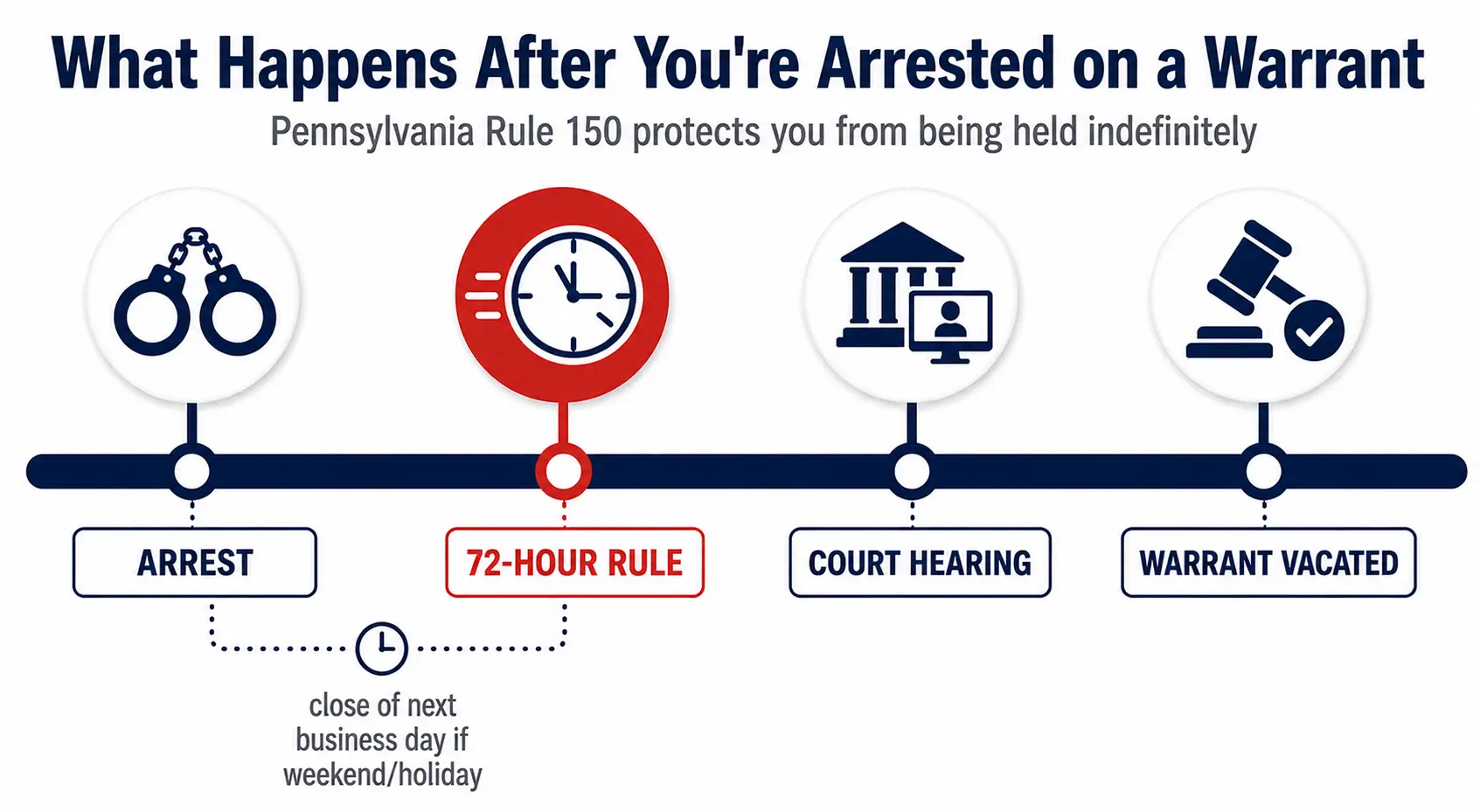
If you are arrested or turn yourself in, the next step is a bench warrant hearing. The law in Pennsylvania provides specific protections to ensure you do not languish in jail indefinitely. Under Rule 150 of the Rules of Criminal Procedure, you must be brought before a judge “without unnecessary delay.” Specifically, you cannot be held for more than 72 hours (or the close of the next business day if the 72 hours expires on a weekend or holiday) without a hearing.
During this hearing, the judge will ask why you failed to appear or comply. This is not a trial about your original charges; it is strictly a hearing about your absence. Pennsylvania courts frequently conduct these hearings via two-way audio-video communication, meaning you might be in a holding facility while the judge is in the courtroom.
If the judge accepts your explanation, or if your attorney successfully advocates for you, a new date is set for your original case. Once you have appeared before the court, the warrant is officially vacated (canceled) and removed from the system.
What to Do Right Now If You Have a Bench Warrant in Bucks County
If you know or suspect you have an active warrant right now, panic will not help you, but swift action will. Follow these exact steps to protect yourself.
- Stop driving immediately. Traffic stops are a common way people with active warrants end up in handcuffs, so do not risk driving until this is resolved.
- Do not go to the police station. As cautioned earlier, walking into a local department in Doylestown or anywhere else in the county will simply trigger your immediate arrest.
- Gather your documents. Find any paperwork regarding your case, including old court notices, citations, bail paperwork, or receipts for fines paid.
- Write down your timeline. Document exactly why you missed your date and gather evidence, like medical records or towing receipts, to turn a weak excuse into a strong legal argument.
- Contact a legal professional. Do not try to call the District Attorney or the judge yourself; let a professional act as a shield between you and the court system.
How Penglase & Benson Can Help
Navigating the court system when you are already in trouble is overwhelming. You need someone who knows the local judges, understands the specific procedures in Bucks and Montgomery counties, and knows how to negotiate with local prosecutors.
As a dedicated bench warrant attorney, the team at Penglase & Benson can discreetly verify the details of your warrant, draft and file the necessary motions to lift it, and fight to prevent the judge from revoking your bail or keeping you in custody on a probation detainer.
Visit our Contact Page to send us a message and schedule your free consultation today.
Frequently Asked Questions About Bench Warrants in PA
Are bench warrants public record?
Yes, they are generally part of the public record. Anyone who searches the Pennsylvania UJS portal can see that an order was issued for your arrest, including the date and the reason. It remains visible on your docket until the issue is resolved and the case is closed or expunged.
Do bench warrants show up on background checks?
In most cases, yes. Warrants are entered into statewide (JNET) and national (NCIC) databases. When an employer, landlord, or licensing board runs a criminal background check, an active warrant will almost always appear.
Can I be arrested in another state on a Pennsylvania bench warrant?
Yes, because warrants are entered into the national NCIC database, out-of-state police will see the Pennsylvania order if they run your ID. Depending on the underlying charge, Pennsylvania authorities can initiate extradition proceedings to transport you back.
How long does it take to clear a bench warrant?
The timeline varies depending on the county and the judge handling your case. If your attorney files a motion to quash, the court may rule on it within a few days. If an in-person hearing is required, it typically depends on the court’s scheduling availability.
Can I have an active warrant without knowing about it?
Yes, it is surprisingly common to have a warrant without realizing it. If a court summons or notice was mailed to an old address, or if it was lost in the mail, the judge may still issue an order for your arrest when you fail to appear.

