
Expungement in Pennsylvania gives you the legal right to wipe a past mistake from your record – but not everyone qualifies, and the process is more complex than most people realize. Whether you are applying for a new career opportunity, attempting to rent an apartment, or seeking a state license, a standard background check can instantly bring your darkest moments to the surface.
The frustration of being held back by a dismissed charge, a minor summary offense from years ago, or an old mistake is overwhelming. You have paid your dues and moved forward, yet the legal system seemingly refuses to let you go. Fortunately, Pennsylvania law offers a powerful legal tool designed to help you wipe the slate clean and finally move on with your life without the shadow of a criminal history.
Criminal record expungement is a legal process intended to permanently remove specific arrests and convictions from public view. However, navigating the strict eligibility requirements and complex court filing procedures can be confusing. Let’s break down exactly what expungement entails, who qualifies under Pennsylvania law, and the actionable steps you need to take to clear your name and reclaim your future.
What Is Criminal Record Expungement in Pennsylvania?
In Pennsylvania, an expungement is a formal court order directing law enforcement agencies and the courts to remove records of a specific arrest, charge, or conviction from public access and requiring those agencies to comply with Pennsylvania expungement procedures.
When a judge signs an expungement order, it generally means the incident is removed from publicly accessible criminal history records. This process offers several life-changing benefits:
- Clears public databases: The record is typically removed from the Pennsylvania State Police database and public court dockets (like the UJS Portal).
- Restores your reputation: The incident generally will not appear on standard employment or housing background checks.
- Allows you to move forward: In most everyday situations, such as a standard job application, once a record is fully expunged, you are generally not required to disclose that specific incident, though certain specialized government, law enforcement, or state licensing applications may still maintain specific disclosure requirements.
Who Qualifies for Expungement in Pennsylvania
Expungement is not available for everyone or every type of crime. Pennsylvania law limits this remedy to specific, qualifying circumstances.
ARD Program Completions
If you successfully completed the Accelerated Rehabilitative Disposition (ARD) program for a first-time, non-violent offense (such as a first-time DUI), you are generally eligible to have the record of the arrest and program participation expunged.
- Eligibility: Applies upon successful completion of your ARD requirements.
- Filing requirements: While some counties initiate this process automatically upon completion, you may often need to file a formal petition to ensure the record is properly cleared.
Summary Offenses
Summary offenses are minor infractions, such as disorderly conduct, underage drinking, or retail theft of a very low value.
The 5-Year Rule: Under Pennsylvania law, you may generally petition to expunge a summary offense conviction if you have been free from arrest or prosecution for five consecutive years following the date of your conviction.
Charges That Were Dismissed or Resulted in Acquittal
One of the most misunderstood aspects of the justice system is the belief that dropped charges disappear automatically.
- Public visibility: If you were arrested but the charges were withdrawn, dismissed, or you were found not guilty at trial, the record of the arrest still exists and is visible to the public.
- Immediate eligibility: Fortunately, you are generally eligible to petition the court to expunge these non-conviction records immediately.
What Crimes Cannot Be Expunged in Pennsylvania
The courts generally reserve expungement for minor offenses and non-convictions. The vast majority of standard misdemeanor and felony convictions cannot be expunged under Pennsylvania law.
Exceptions are incredibly narrow. Typically, a misdemeanor or felony conviction can only be expunged if the individual reaches the age of 70 and has been free of arrest or prosecution for ten years, or if the individual has been deceased for three years. For individuals seeking to clear standard criminal convictions outside of these parameters, the primary available avenue is generally seeking a pardon from the Governor of Pennsylvania, which is a complex and lengthy process.
How Pennsylvania’s Clean Slate Act Changed Expungement
It is important to distinguish between traditional expungement and the Pennsylvania Clean Slate law. The Clean Slate Act allows for the automated sealing of certain eligible records.
- Sealing vs. Expungement: Clean Slate seals qualifying non-violent misdemeanor (and recently, certain minor felony) convictions from public view after a designated period (typically 7 to 10 years) of remaining conviction-free.
- Who can see it: While sealed records are hidden from standard employers and landlords, they are not removed entirely. Law enforcement, state licensing boards, and the courts can still access sealed records. Expungement, on the other hand, directs agencies to remove the record entirely from public access.
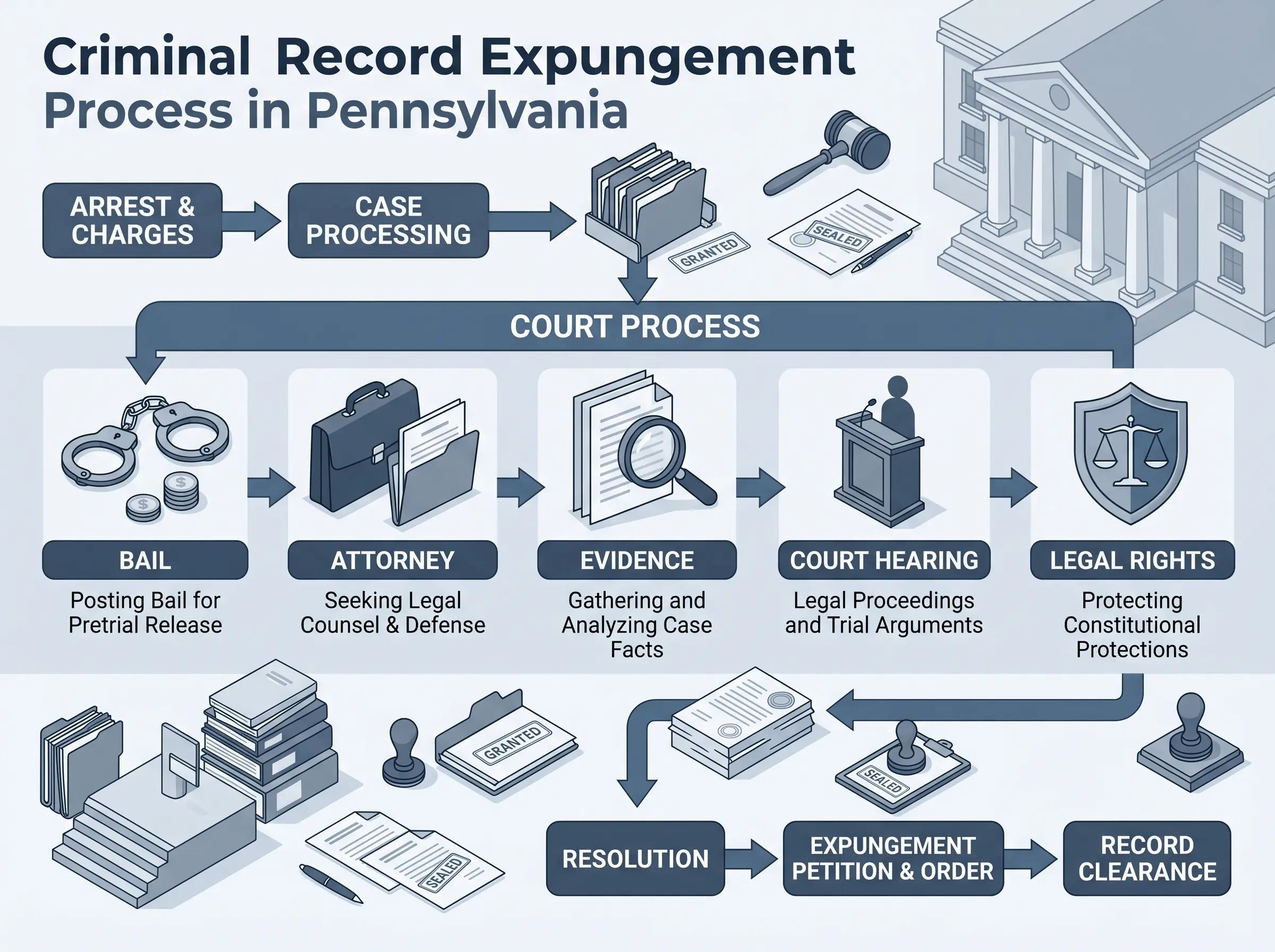
The Expungement Process Step by Step
Securing an expungement requires strict adherence to legal procedures. The process typically involves several key phases.
Filing the Petition
The process begins by obtaining an official copy of your Pennsylvania State Police criminal history and your court disposition documents. Your attorney will use these records to draft a formal Petition for Expungement, which must be accurately prepared and filed in the Court of Common Pleas in the county where the arrest occurred.
What Happens After You File
Once filed, the petition is served to the local District Attorney’s office.
- The Review Period: The District Attorney generally has 30 days to review the petition and either consent or object to the expungement.
- The Hearing: If the prosecution objects, the court will schedule a hearing where your attorney will argue why the expungement should be granted based on statutory guidelines.
- The Order: If there is no objection, or if the judge rules in your favor, the court will sign the expungement order, which is then distributed to the relevant state agencies.
How Long Does Expungement Take in Pennsylvania
Clearing your record is not an overnight process. From the moment the petition is filed at the courthouse, it generally takes between four and six months for the expungement to be fully processed and for the Pennsylvania State Police to process the expungement and update applicable records and databases. Processing times can vary significantly depending on the specific county and current agency backlogs.
What Happens to Your Record After Expungement
Once the expungement order is fully processed by the necessary state and local agencies, the relevant records are removed from public access, and those agencies are directed to comply with the expungement order.
When a standard background check is subsequently run by a private employer, landlord, or financial institution, the expunged incident should no longer appear. This allows you to confidently pursue new opportunities without the anxiety of having to explain a past legal issue.
Common Mistakes People Make When Filing for Expungement
Attempting to navigate the expungement process without legal guidance often leads to frustrating delays and outright denials. Common pitfalls include:
- Assuming dismissed charges vanish: Believing that because a case was thrown out, there is no public record of the arrest.
- Applying too early: Filing a petition before the mandatory statutory waiting period (such as the five years required for summary offenses) has fully elapsed.
- Filing incomplete paperwork: Failing to include the required background checks, certified dispositions, or proper filing fees can result in the petition being rejected by the clerk.
- Confusing sealing with expungement: Assuming that because a record was sealed under Clean Slate, it has been fully expunged and removed from public access.
Steps to Take If You Want to Expunge Your Record
If you are ready to clear your name and explore your eligibility, you should take the following steps:
- Obtain your records: Secure a copy of your criminal history from the Pennsylvania State Police.
- Identify the disposition: Determine exactly how your case concluded (e.g., ARD completion, withdrawn, guilty plea to a summary offense).
- Consult with legal counsel: Have a qualified attorney review your specific history to verify your eligibility before you spend money on non-refundable court filing fees.
How Penglase & Benson Can Help
At Penglase & Benson, we believe that your past mistakes should not dictate your future opportunities. We understand how important it is to have a clean record when seeking employment, housing, or career advancement.
Our attorneys focus on streamlining the expungement process for our clients. We will evaluate your criminal history, gather the necessary court documents, draft and file the formal petition, and represent you in court if the District Attorney raises an objection. We handle the complex legal procedures so you can focus on moving forward with your life.
Visit our Contact Page to send us a message and schedule your free consultation today.
Frequently Asked Questions
Do I have to go to court for an expungement?
In many cases, you do not have to appear in court. If the District Attorney consents to your expungement petition, a judge will often sign the order without requiring a hearing. However, if the prosecution objects to the petition, a hearing will be scheduled, and your attorney will need to advocate on your behalf before a judge.
Will employers see an expunged record?
Generally, no. Once a record is fully expunged, it is removed from public databases, meaning it will not appear on standard background checks conducted by private employers, landlords, or educational institutions.
Can a DUI be expunged in Pennsylvania?
A standard DUI conviction generally cannot be expunged in Pennsylvania. However, if you successfully completed the Accelerated Rehabilitative Disposition (ARD) program for your DUI, or if the DUI charges were ultimately dismissed or withdrawn, those specific records are typically eligible for expungement.
Does the Clean Slate Act mean I don’t need to file for expungement?
No. The Clean Slate Act automatically seals eligible records from public view, but it does not remove them entirely; law enforcement and certain state agencies can still see sealed records. If you have non-conviction records or ARD completions, it is generally highly recommended to file for a full expungement to have those records completely removed from public access.
Can I buy a gun after an expungement?
An expungement may help restore certain rights under Pennsylvania law if the specific expunged charge was the sole legal barrier to purchasing or possessing a firearm. However, federal firearm laws are highly complex, and eligibility can still depend on various other legal factors and federal statutes. You should consult with an attorney to confirm your legal standing before attempting to purchase a firearm.

