
Securing a probationary sentence rather than serving time behind bars is often a massive relief for anyone navigating the criminal justice system. It allows you to maintain your career, stay with your family, and move forward with your life while fulfilling your obligations to the court. However, this conditional freedom comes with strict rules, and a single misstep can instantly jeopardize everything you have worked so hard to preserve.
When a probation officer believes you have failed to comply with the terms of your supervision, the legal backlash is swift and severe. Unlike a standard criminal charge, where you are presumed innocent, and the process moves methodically, a probation violation in Pennsylvania triggers a unique, accelerated legal process. In a matter of hours, you can go from living out in the community to sitting in a county jail under a probation detainer.
The fear and uncertainty of facing a probation revocation are overwhelming, but assuming that a violation automatically guarantees a lengthy prison sentence is a mistake. To protect your freedom, you need a clear understanding of the rules governing community supervision, how the courts handle these specific hearings, and the strategic defense actions required to fight the allegations.
What Is Probation in Pennsylvania
In Pennsylvania, probation is a court-ordered period of correctional supervision in the community, generally serving as an alternative to incarceration. It allows individuals convicted of certain offenses to serve their sentence outside of jail, provided they strictly adhere to specific conditions set by a judge.
While on probation, you remain under the jurisdiction of the court and are supervised by a county or state probation officer. The primary goal of this supervision is rehabilitation, but the system is heavily focused on compliance. If the court determines you are not following the mandated rules, they retain the authority to revoke your probation and impose the original jail or prison sentence.
What Counts as a Probation Violation in Pennsylvania
A probation violation in Pennsylvania occurs when you fail to abide by any of the specific terms and conditions outlined in your sentencing order. The courts generally divide these infractions into two distinct categories: technical violations and new criminal offense violations.
Technical Violations
A technical violation happens when you break a specific rule of your probation, even if the act itself is not inherently a crime. Because probation conditions are highly restrictive, technical violations are incredibly common. Examples generally include:
- Failing a drug or alcohol test: Testing positive for illegal substances or consuming alcohol if restricted by your judge.
- Missing appointments: Failing to report to your probation officer for scheduled check-ins.
- Failing to complete required programs: Not attending court-ordered anger management, DUI classes, or substance abuse treatment.
- Leaving the jurisdiction: Traveling outside of the county or state without prior permission and a valid travel pass from your officer.
- Failing to pay fines and restitution: Falling behind on mandatory court costs or victim restitution payments.
New Criminal Offense Violations
A new criminal offense violation – often referred to as a direct violation – occurs when you are arrested and charged with a new crime while under active supervision.
This type of violation is particularly dangerous. Not only do you have to defend yourself against the new criminal charges, but an arrest may provide the basis for initiating probation violation proceedings. Furthermore, the standard of proof in a probation hearing is significantly lower than in a criminal trial, meaning you could potentially be found in violation of your probation depending on the evidence presented during the revocation hearing, even if the new criminal charges are later dismissed.
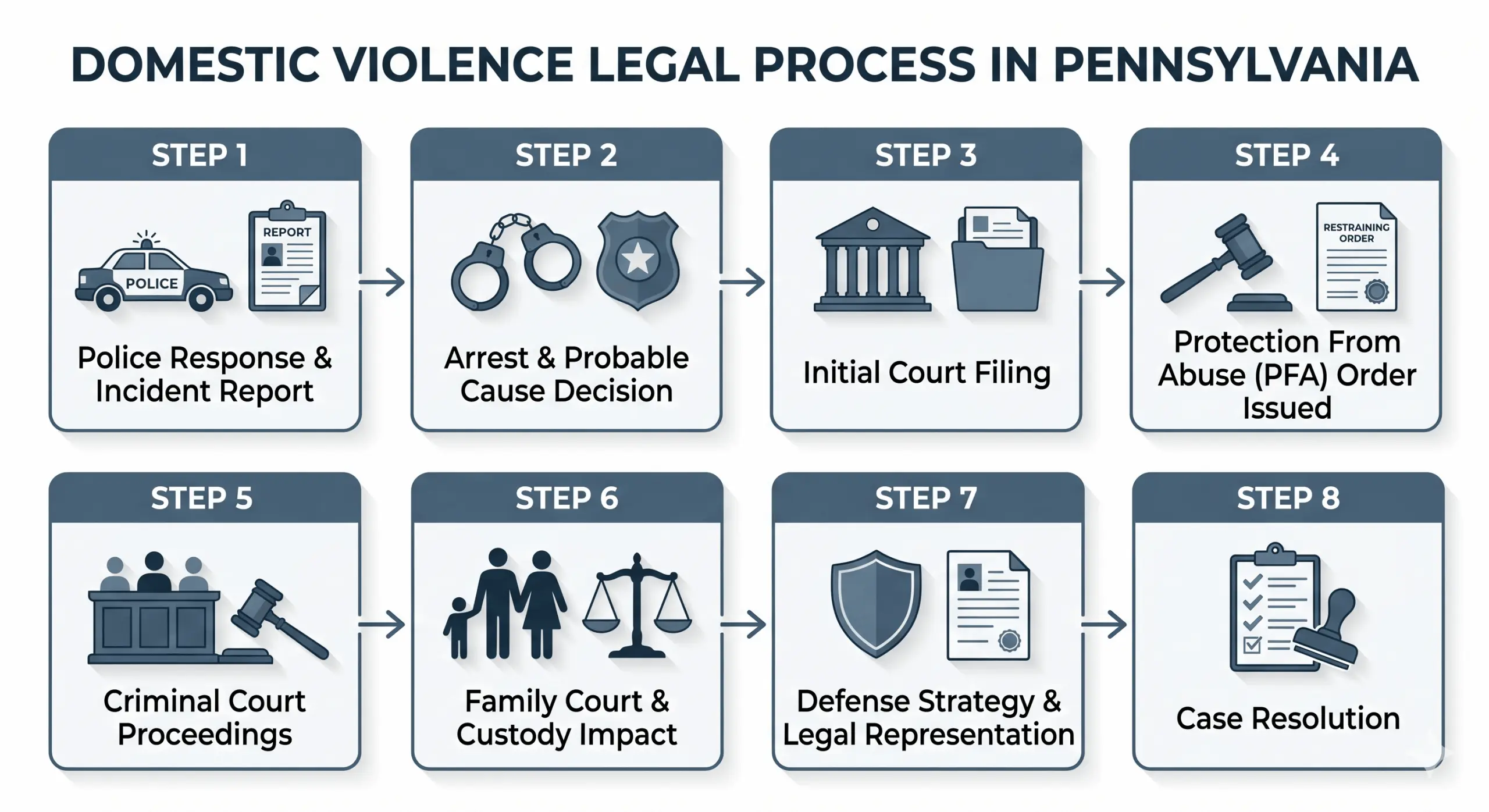
How Pennsylvania Handles Probation Violation Hearings
The process for handling a probation violation in Pennsylvania is entirely different from a standard criminal trial. You do not have the right to a jury, and the legal procedures move rapidly.
The Detainer and Arrest Process
If your probation officer suspects a violation, they may issue a probation detainer. A detainer is a legal hold placed upon you that generally requires law enforcement to arrest you and keep you in custody.
Unlike a standard criminal arrest, where you are entitled to a bail hearing, individuals held solely on a probation detainer are generally not entitled to traditional bail proceedings. This means you may remain incarcerated in the county jail until your violation hearings are fully resolved, which can sometimes take weeks or months.
What Happens at a Pennsylvania Probation Violation Hearing
Pennsylvania utilizes a two-step hearing process, commonly referred to as Gagnon hearings, to address probation violations:
- Gagnon I Hearing (Preliminary Hearing): This is a brief, initial hearing held shortly after you are detained. The judge or hearing officer determines whether there is “probable cause” to believe a violation occurred.
- Gagnon II Hearing (Final Hearing): This is the formal revocation hearing. The judge will hear testimony, review evidence, and decide if a violation actually occurred based on a “preponderance of the evidence.” If found in violation, the judge will then proceed to resentence you.
Penalties for Violating Probation in Pennsylvania
If a judge determines that you committed a probation violation in Pennsylvania, they have broad discretion during resentencing. Depending on the severity of the violation, your prior record, and the original charge, the judge may impose a variety of penalties, including:
- Reinstatement of Probation: The judge may simply give you a warning and allow you to remain on probation under the original terms.
- Modification of Conditions: The court may add stricter rules, such as mandatory inpatient rehab, electronic home monitoring, or more frequent reporting requirements.
- Extension of Probation: The judge may extend the length of your probationary period.
- Revocation and Incarceration: The most severe penalty is the full revocation of your probation. The judge can order you to serve time in a county jail or state prison, potentially up to the statutory maximum sentence allowed for your original underlying crime.
How a Probation Violation Affects Your Life Beyond the Courtroom
The collateral damage of a probation violation extends well beyond the threat of new criminal penalties. The sudden nature of a probation detainer can completely upend your daily life.
Because detainers generally do not allow for bail, being taken into custody can result in immediate job loss, as you are suddenly unable to show up for work. The loss of income can quickly lead to housing instability, evictions, or the inability to pay child support. The disruption to your family life and personal obligations makes fighting a detainer and resolving the violation as quickly as possible an absolute priority.
Can a Probation Violation Be Defended Against
Yes, absolutely. A field violation is not the same thing as a conviction. An experienced defense attorney can often challenge the allegations or present mitigating evidence to the judge. Strategic defenses often include:
- Challenging technical evidence: Disputing the accuracy of false-positive drug tests or proving that administrative errors caused missed appointments.
- Providing mitigating context: Explaining unavoidable circumstances, such as medical emergencies or severe financial hardship, that caused you to fall behind on fines or miss a meeting.
- Negotiating alternatives: Presenting a proactive plan to the judge, such as voluntarily entering a treatment facility, to demonstrate that rehabilitation is a better option than incarceration.
Common Mistakes People Make After a Probation Violation
When individuals realize they have violated their probation, panic often leads to poor decision-making that significantly worsens their legal standing. You should generally avoid these common pitfalls:
- Absconding (going on the run): Stopping communication with your probation officer because you failed a drug test or missed a payment often results in a warrant being issued for your arrest.
- Admitting guilt immediately: Confessing to technical violations or new crimes during a check-in with your probation officer can provide the state with direct evidence to use against you at a Gagnon hearing.
- Ignoring the issue: Hoping a missed appointment or an unpaid fine will simply be forgotten rarely works, as probation systems heavily rely on automated tracking.
- Waiting to hire counsel: Delaying legal representation often means sitting in jail on a detainer longer than necessary while the system processes your case.
Steps to Take Immediately After a Probation Violation
If you know you have violated a condition of your supervision, or if you learn that a detainer has been issued, you should take the following steps to protect yourself:
- Do not run: Continue to comply with your other conditions as best as possible while addressing the issue legally.
- Gather documentation: Collect proof of your employment, medical records, or receipts for paid fines that might explain the alleged violation.
- Exercise your right to remain silent: Do not discuss the details of new criminal charges or the violation with law enforcement or your probation officer without counsel present.
- Contact a defense attorney: Retain legal counsel immediately so they can file motions to potentially lift the detainer and begin building a defense strategy for your Gagnon hearings.
How Penglase & Benson Can Help
At Penglase & Benson, we understand how stressful it is to face the possibility of losing your freedom over a probation issue. We know that the system is rigid and often unforgiving, but a probation violation in Pennsylvania does not have to result in the maximum possible jail sentence.
Our attorneys focus on strategic advocacy during Gagnon hearings and detainer resolutions. We will thoroughly review your supervision history, analyze the specific allegations made by your probation officer, and present compelling arguments to the judge to help protect your freedom, lift your detainer, and keep you in the community.
Visit our Contact Page to send us a message and schedule your free consultation today.
Frequently Asked Questions
Can I get bail if I have a probation detainer?
Generally, no. A standard bail hearing does not apply to a probation detainer, meaning you will typically be held in custody. However, your defense attorney can file a formal Motion to Lift Detainer, requesting the judge to review the circumstances and potentially release you pending your formal violation hearing.
Do I need a lawyer for a probation violation hearing?
Yes, it is highly recommended. Because the standard of proof is lower than in a criminal trial and you do not have the right to a jury, it is much easier for the state to prove a violation. Having a lawyer advocate for you is crucial to challenge the evidence and negotiate for alternatives to jail time.
What is a Gagnon hearing?
In Pennsylvania, Gagnon hearings are the formal court proceedings used to handle probation violations. A Gagnon I hearing determines if there is probable cause that a violation occurred, while a Gagnon II hearing is the final proceeding where the judge decides if you are in violation and determines your new sentence.
Will I automatically go to jail for a failed drug test?
Not automatically. While a failed drug test is a technical violation, judges and probation officers have discretion. Depending on your prior record, your level of compliance, and your attorney’s advocacy, the court may order you to attend outpatient or inpatient rehabilitation instead of sending you to jail.
What happens if I move out of state without permission?
Leaving the state without an approved travel pass or a formal transfer of your probation through the Interstate Compact is a serious technical violation (often called absconding). Courts frequently issue warrants in these circumstances, and if you are caught in another state, you may be held in custody and extradited back to Pennsylvania to face a revocation hearing.

