
A household dispute escalating into legal action can turn your world upside down in a matter of hours. When law enforcement officers arrive at a residence following a disturbance call, they may make an arrest when they determine probable cause exists that a crime occurred. In an instant, you may find yourself removed from your own home, separated from your children, and thrust into the complexities of the justice system.
Domestic violence in Pennsylvania is uniquely challenging because these cases often operate simultaneously on two separate legal fronts: the criminal courts and the civil family courts. The state takes these allegations incredibly seriously. Because of strict public policy, prosecutors generally pursue these cases assertively, often moving forward with charges even if the original accuser later decides they no longer wish to participate in the process.
You cannot afford to wait and assume the situation will simply resolve itself once tempers cool. Protective orders and criminal proceedings move rapidly, and the consequences can alter the trajectory of your life. To protect your freedom, your reputation, and your relationship with your family, you need a clear understanding of the laws governing domestic violence in Pennsylvania and a well-structured defense strategy to address them.
What Is Considered Domestic Violence Under Pennsylvania Law
In Pennsylvania, “domestic violence” is not actually a single, standalone criminal charge. Instead, it is a classification applied to existing criminal offenses – such as assault or harassment – when the crime is committed against a specific type of family or household member.
Who Can Be Considered a Victim Under PA Law
For a crime to be classified as domestic violence, it must involve an accuser who falls into specific relationship categories defined by state law. These categories generally include:
- Current or former spouses: This applies whether you are actively married, currently separated, or your divorce has been finalized for years.
- Individuals who have lived together as intimate partners: This covers cohabitating romantic partners, even if you are not legally married or no longer reside at the same address.
- Parents and children: This broadly includes biological children, legally adopted children, and stepchildren within the household.
- Individuals who share a child together: You fall into this category if you have a biological or legally adopted child together, regardless of whether you ever married or lived together.
- Other blood relatives or individuals related by marriage: This category can encompass siblings, cousins, and in-laws who share a recognized familial bond under the law.
Types of Abuse Pennsylvania Law Recognizes
The domestic violence label can be attached to a wide variety of criminal offenses. Here is a breakdown of the most common charges associated with these household disputes:
| Criminal Charge | General Definition Under PA Law | Example Scenario |
| Simple Assault | Causing or attempting to cause physical injury. | Striking a partner during an argument, resulting in bruising. |
| Aggravated Assault | Attempting to cause or intentionally causing serious bodily injury. | Using a weapon or inflicting severe injuries that require hospitalization. |
| Harassment | Engaging in a course of conduct intended to annoy, alarm, or subject someone to physical contact. | Repeatedly shoving a spouse or continuously sending threatening text messages. |
| Terroristic Threats | Communicating a threat to commit violence with the intent to terrorize. | Threatening to physically harm a partner or their property during a heated dispute. |
| Stalking | Repeatedly following or communicating with someone in a way that causes fear of bodily injury or emotional distress. | Continuously showing up uninvited at a former partner’s workplace or home. |
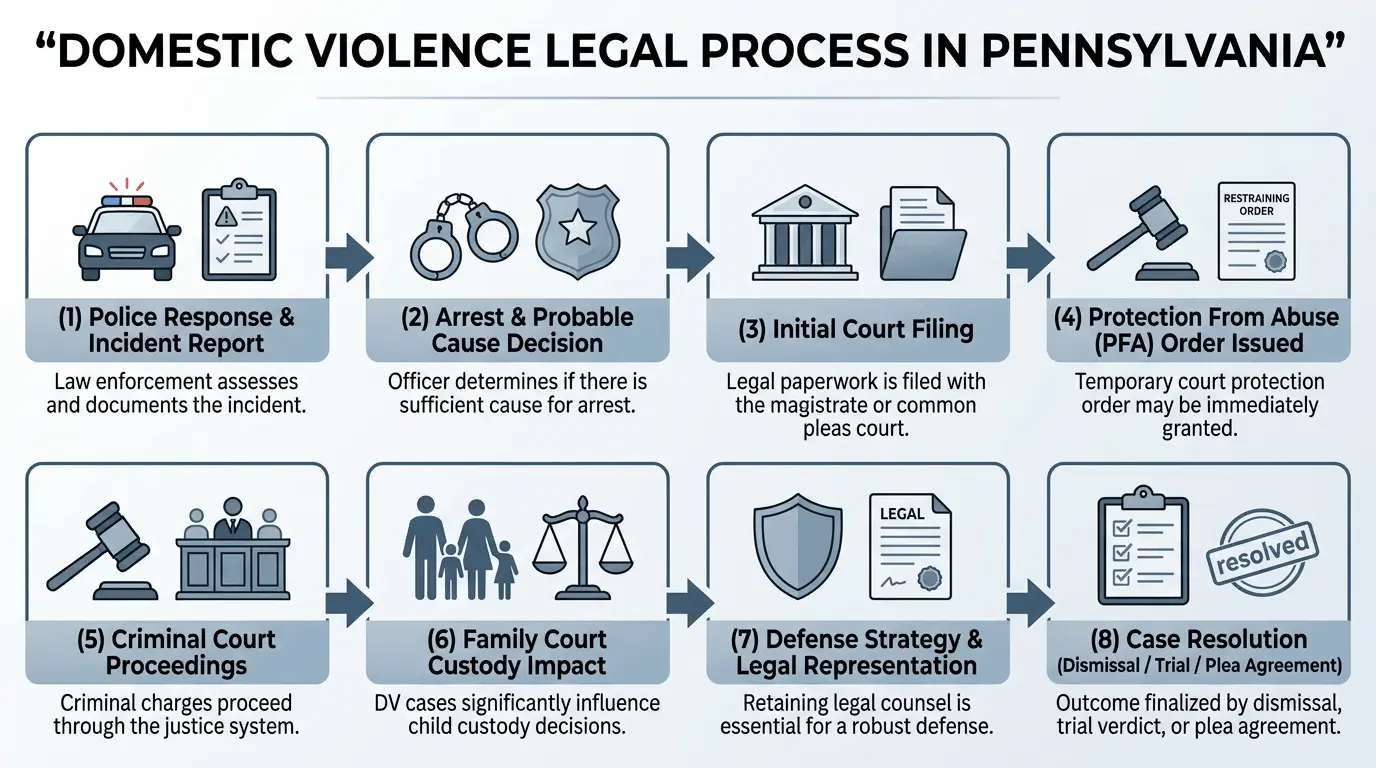
How Domestic Violence Charges Are Filed in Pennsylvania
Understanding how these cases are initiated is crucial for your defense. Many individuals mistakenly believe that the accuser is the one who “presses charges” or that the accuser can simply “drop the charges” the next day.
In reality, when police officers respond to a domestic call, they evaluate the scene for probable cause. If they observe injuries, property damage, or gather witness statements suggesting a crime occurred, they may make an arrest based on that probable cause. Once the police file their report, the local District Attorney’s office assumes full control of the case. The Commonwealth of Pennsylvania brings the domestic violence charges, meaning only the prosecutor has the legal authority to dismiss or reduce them.
The Protection From Abuse (PFA) Order: What It Means for You
Domestic violence cases in Pennsylvania are frequently accompanied by a Protection From Abuse (PFA) order. A PFA is a civil court order generally designed to restrict an individual from having contact with the accuser.
Emergency PFA Orders
An emergency or temporary PFA is often granted ex parte, meaning the judge can issue the order based solely on the accuser’s testimony without you being present to defend yourself. The immediate restrictions of a temporary PFA can be severe and may require you to:
- Immediately vacate your shared home: A judge may order your eviction from your primary residence, even if your name is solely on the lease or mortgage document.
- Cease all contact with the accuser: This generally prohibits any form of communication, including phone calls, text messages, emails, or messages relayed through third-party mutual friends.
- Face temporary restrictions on child custody: Temporary restrictions on your physical custody or visitation privileges may be imposed pending a formal hearing.
- Relinquish all firearms to law enforcement: You may generally be required to surrender any guns, ammunition, and concealed carry permits to the local sheriff or police department for the duration of the order.
Final PFA Orders and Court Hearings
A temporary PFA is only valid until a formal hearing can be held, typically within 10 days. At the final PFA hearing, you have the right to legal representation, the right to present evidence, and the right to cross-examine the accuser. If the judge grants a final PFA, the restrictive order can remain in effect for up to three years.
Penalties for Domestic Violence in Pennsylvania
Because domestic violence encompasses a variety of specific crimes, the potential penalties depend heavily on the underlying charge and its grading (whether it is classified as a misdemeanor or a felony). Depending on the severity of the allegations, a conviction may result in:
- Incarceration: Sentences ranging from a few months in a county jail for minor misdemeanors to several years in a state prison for severe felonies.
- Fines and Restitution: Significant financial penalties and court costs.
- Probation: Lengthy periods of strict court supervision.
- Mandatory Programming: Court-ordered completion of anger management classes or Batterer’s Intervention Programs.
How a Domestic Violence Charge Affects Your Life Beyond the Courtroom
The consequences of a conviction extend far beyond criminal penalties, often creating long-lasting roadblocks in your personal life and career.
Impact on Child Custody and Divorce
Family courts take domestic violence allegations very seriously. An active PFA or a criminal conviction can severely jeopardize your standing in family court proceedings. It may negatively affect custody determinations, parenting time arrangements, or visitation rights, and can sometimes lead to the imposition of strictly supervised visitation or impact your position in a divorce settlement.
Impact on Your Firearm Rights
A domestic violence conviction carries severe constitutional consequences. A conviction for a misdemeanor crime of domestic violence typically results in a lifetime federal firearm prohibition under the Lautenberg Amendment. It may also result in additional state-level firearm restrictions depending on the specific conviction and circumstances. Furthermore, an active final PFA order also generally restricts your firearm rights for the duration of the order.
What to Do If You Have Been Falsely Accused of Domestic Violence
Domestic violence cases sometimes arise during highly contentious divorces, separations, or heated child custody battles where the facts may be heavily contested. In these emotionally charged situations, allegations require careful, independent investigation to uncover the truth.
Defeating unsubstantiated domestic violence charges in Pennsylvania requires a highly strategic defense. It is generally necessary to proactively gather independent evidence to challenge the narrative presented to law enforcement. This often involves:
- Securing digital evidence, such as text messages, emails, or voicemails that show context or a motive to lie.
- Compiling witness testimony to establish alibis or provide context to the dispute.
- Highlighting inconsistencies in the accuser’s statements to law enforcement.
Common Mistakes People Make After a Domestic Violence Arrest
When emotions run high, individuals often make critical errors that inadvertently strengthen the prosecution’s case against them. If you are facing domestic violence charges in Pennsylvania, you should generally avoid these common pitfalls:
- Violating a no-contact order: Attempting to contact the accuser – even just to apologize or ask them to drop the charges – may be treated as a separate crime (Indirect Criminal Contempt) that can result in additional jail time.
- Trying to explain your side to the police: Speaking to law enforcement without an attorney present often provides prosecutors with statements that can be used against you.
- Venting on social media: Posting about your relationship, the accuser, or the arrest may provide investigators with a public record of your emotional state.
- Asking third parties to pass along messages: Using a friend or family member to communicate with the accuser is generally treated as a violation of a PFA or bail conditions.
Steps to Take Immediately After Being Charged
To protect your freedom and begin building a robust defense strategy, you should take the following steps the moment you are released or served with a PFA:
- Exercise your right to remain silent: Do not discuss the incident with law enforcement or investigators without legal counsel.
- Strictly obey all court orders: Comply entirely with the conditions of your bail and any temporary PFA, regardless of whether you believe the restrictions are unfair.
- Preserve all communication: Save text messages, emails, and call logs that may be relevant to the relationship or the specific incident.
- Retain defense counsel: Hire a qualified criminal defense attorney as early in the process as possible to ensure your rights are protected before evidence is lost or court deadlines expire.
How Penglase & Benson Can Help
At Penglase & Benson, we understand that domestic disputes are complex and that there are two sides to every story. A domestic violence allegation does not mean a conviction is inevitable. You have fundamental legal rights, and you deserve a defense strategy tailored to the unique facts of your case.
Our attorneys focus on developing practical, strategic defenses for individuals facing domestic violence charges in Pennsylvania. We will carefully review the police reports, analyze any accompanying PFA filings, and represent you vigorously in both criminal and civil proceedings to help protect your freedom and your family.
Visit our Contact Page to send us a message and schedule your free consultation today.
Frequently Asked Questions
Can the victim drop domestic violence charges in Pennsylvania?
No. Once the police make an arrest and file a report, the decision to proceed with the case belongs entirely to the District Attorney’s office. While a prosecutor may consider an accuser’s reluctance to testify, the accuser does not have the legal authority to simply drop or dismiss the charges.
Will I lose my guns if a PFA is filed against me?
In most cases, yes. Under Pennsylvania law, a judge issuing a PFA often requires the defendant to relinquish all firearms, other weapons, and any concealed carry permits to law enforcement for the duration of the order. Furthermore, a conviction for a misdemeanor crime of domestic violence typically triggers a lifetime federal firearm prohibition under the Lautenberg Amendment, and may also result in additional state-level firearm restrictions depending on the conviction and circumstances.
Is a Protection From Abuse (PFA) order a criminal conviction?
No, a PFA itself is a civil court order, not a criminal conviction, and it will generally not appear on a standard criminal background check. However, if you violate the conditions of the PFA, you may be arrested and charged with Indirect Criminal Contempt, which is a criminal offense that can potentially result in jail time and a permanent record.
What happens if I accidentally violate a no-contact order?
Courts often treat even brief or unintended contact very seriously. While the specific circumstances matter, any alleged violation of a PFA or bail condition – whether you accidentally encountered the accuser in public or briefly replied to a text message – can potentially result in significant legal consequences, including the risk of arrest and additional criminal charges.
Can domestic violence charges be expunged in PA?
If you are convicted of a misdemeanor or felony related to domestic violence, the conviction generally cannot be expunged under Pennsylvania law without a Governor’s pardon. However, if the domestic violence charges in Pennsylvania are dismissed, withdrawn, or you are found not guilty at trial, you may be eligible to petition the court to have the arrest record expunged.

