
It often starts with small things. A child who used to run to the door when you arrived suddenly hangs back. Phone calls are cut short or ignored entirely. Soon, your child might start using words that sound strangely like their other parent, reciting adult grievances and treating you with a cold, unexplained hostility.
For a parent going through a separation or divorce, watching your own child become a stranger is terrifying. The confusion builds as the relationship you nurtured over the years seems to erode in a matter of months. You might feel helpless, wondering if you did something wrong or if the other parent is orchestrating this sudden distance behind the scenes.
When one parent actively works to turn a child against the other, the legal system provides ways to intervene. However, the path forward requires a calm, strategic approach centered on your child. Navigating parental alienation in Pennsylvania means understanding what family courts look for, how to gather the right kind of proof, and which legal steps protect your relationship without causing more trauma.
What does parental alienation actually mean?
Parental alienation occurs when one parent deliberately damages the relationship between the child and the other parent. Research suggests that alienating dynamics appear in a meaningful share of contested custody cases. This behavior can be obvious, like forbidding a child to speak to you, or subtle, like sighing and looking sad every time the child mentions your name.
The alienating parent uses emotional pressure to align the child exclusively with them. They create a dynamic where the child feels forced to reject you simply to survive the environment in the other home.
The difference between parental alienation and parental alienation syndrome
When searching for answers, you will likely encounter the phrase “parental alienation syndrome.” This term was introduced by a psychiatrist in the 1980s, but it is not a recognized medical or psychological diagnosis. The major diagnostic manuals used by mental health professionals do not include it.
However, Pennsylvania family courts recognize the destructive behaviors involved. Some authorities and legal professionals characterize serious coaching and isolation as a form of emotional abuse. Judges understand that this type of harm requires attention. The focus in a courtroom is never on diagnosing a syndrome. Instead, the court focuses on the specific, documented actions of the other parent and how those behaviors negatively impact the child.
What are the common signs and examples of parental alienation?
Identifying these behaviors early can be difficult because they happen behind closed doors. Courts look for patterns over time rather than isolated bad days.
Recognizing the signs of parental alienation early can help you document the problem before it damages the parent-child trust. Common warning signs include:
- Badmouthing and criticizing: The other parent constantly speaks poorly about you in front of the child, sharing inappropriate details about adult conflicts or financial issues.
- Interfering with contact: Your scheduled parenting time is frequently canceled for vague reasons. Phone calls and text messages are monitored, blocked, or ignored.
- Rewriting history: The child suddenly claims you were never around or never cared, contradicting years of happy memories and photographs.
- Guilt-tripping the child: The other parent makes the child feel bad for loving you or enjoying their time at your house.
- Unfounded accusations: The other parent coaches the child to report neglect or harm that never occurred, weaponizing the legal or child welfare systems.
When is it estrangement, not alienation?
Courts are careful to distinguish between a pressured child and a child who has withdrawn for a valid reason. Estrangement happens when a child creates distance due to genuine conflict, harsh parenting, or actual safety concerns.
If a parent has a history of substance abuse or domestic violence, a child seeking space is a natural, protective response. Alienation lacks a legitimate foundation. The child’s hostility in an alienation scenario is manufactured by the other parent, not earned by your actions.
How does parental alienation affect children?
The true victim in any alienation scenario is the child. They are forced to carry an adult burden and reject half of their own identity. The damage often extends far beyond the immediate custody dispute, and it also takes a significant emotional toll on the rejected parent.
- Emotional distress: Children experience anxiety and depression from living in a constant state of loyalty conflict.
- Loss of identity: Because children see themselves as half of each parent, rejecting one parent often leads to a rejection of their own self-worth.
- Future trust issues: The pressure teaches children that love is conditional and relationships are unsafe, which can impact their adult relationships later in life.
Is parental alienation illegal or a crime in Pennsylvania?
Many worried parents want to know whether parental alienation is illegal in a criminal sense. In Pennsylvania, this behavior is not a standalone crime. You cannot call the police and have your ex-spouse arrested simply for speaking poorly about you or making the child feel guilty.
Because it is not a criminal offense, the remedies live in the family court. Sometimes, an alienated parent might consider calling ChildLine or child protective services to report the emotional abuse. While coaching a child to hate a parent is harmful, you must be extremely cautious.
Child welfare agencies focus on immediate physical or sexual abuse and neglect. Using these agencies to resolve a custody dispute can backfire, making you look vindictive to a judge. The proper venue for addressing this behavior is always through your county family court system.
How do Pennsylvania courts view parental alienation?
When a judge looks at a family in crisis, their mandate is to protect the well-being of the child. Specific parental alienation laws do not exist as separate statutes in Pennsylvania. Instead, courts evaluate these behaviors under the broad umbrella of state custody laws.
The best interest of the child standard
Every custody decision in Pennsylvania is based on the “best interest of the child“. State law provides a specific list of factors (found in 23 Pa.C.S. Section 5328) that judges must weigh.
Two of these factors address these dynamics directly. First, the court looks at which parent is more likely to encourage and permit frequent and continuing contact between the child and the other parent. Second, the court specifically considers any attempts by a parent to turn the child against the other parent. If you can prove one parent is systematically interfering, it influences the judge’s final custody decision.
Kayden’s Law and the risk of false claims
In 2024, Pennsylvania enacted Kayden’s Law to strengthen child protection in family court. This legislation requires courts to carefully evaluate allegations of abuse and prioritize the safety of the child above all else, including the desire to maintain a relationship with both parents.
This law highlights an important tension. Historically, some abusive parents used claims of alienation to discredit a protective parent who was legitimately reporting abuse. Today, courts in Bucks County and across the state look closely at the context. Judges are trained to distinguish between a parent raising genuine safety concerns under Kayden’s Law and a parent who is actively working to destroy a healthy parent-child bond. Being honest about this nuance is vital when presenting your case.
How can I prove parental alienation in court?
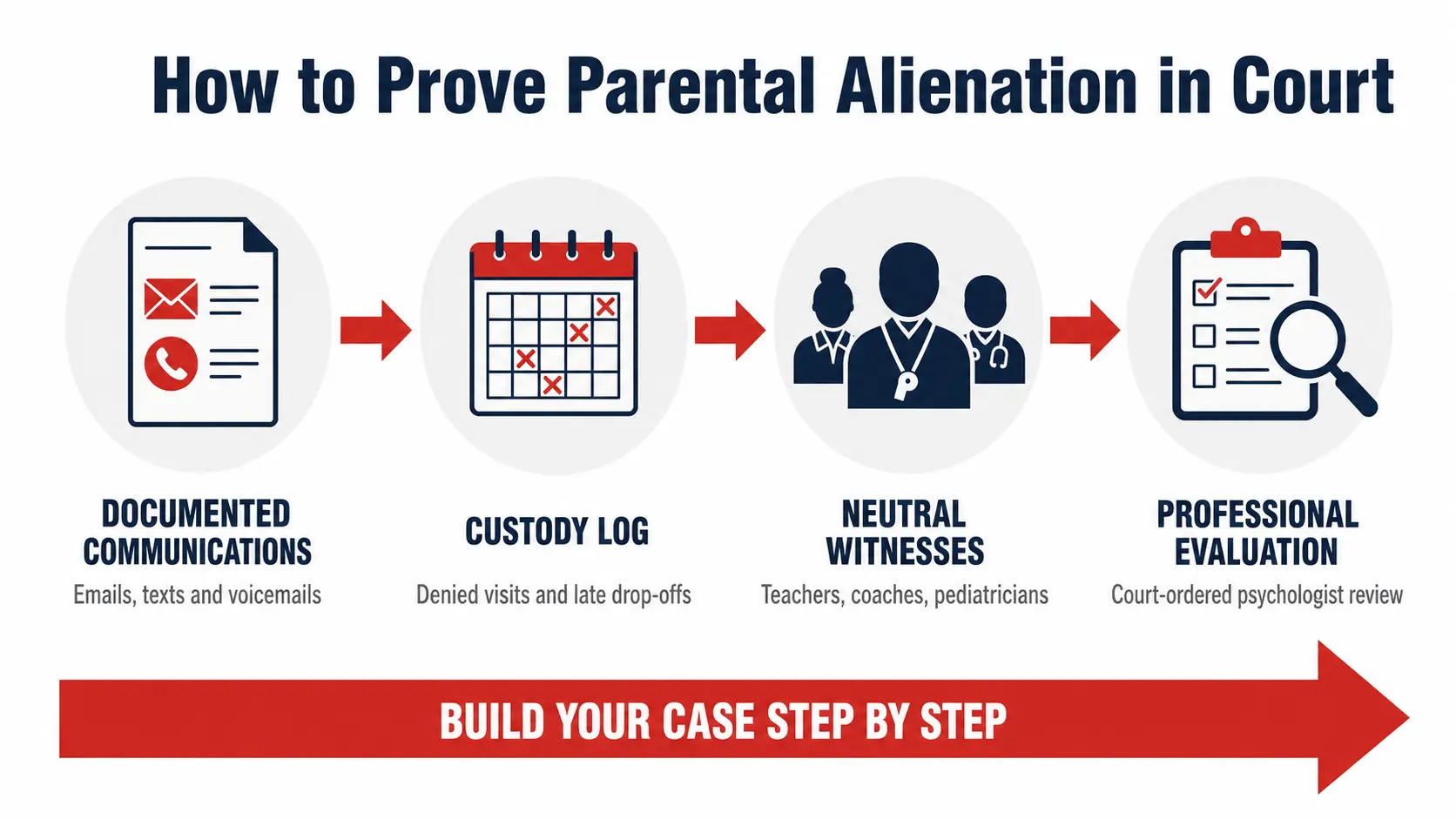
Knowing something is happening and proving it to a judge are two different challenges. Learning how to prove parental alienation requires patience, organization, and a strict adherence to court rules. You must demonstrate a consistent pattern over time, rather than a single bad interaction.
- Documented communications: Save all emails, text messages, and voicemails from your ex-spouse that show hostility, refusal to co-parent, or attempts to block your time.
- A dated custody log: Keep a calendar tracking every denied visit, intercepted phone call, or late drop-off. Facts and dates speak louder than emotional accusations.
- Neutral witnesses: Teachers, coaches, or pediatricians who observe the child’s behavior changing or hear the other parent speaking poorly about you can provide objective testimony.
- Professional evaluations: A court may order a formal custody evaluation by a licensed psychologist. These experts are trained to interview children and uncover whether their hostility is genuine or coached.
What are my legal options and remedies in Pennsylvania?
If you have gathered evidence that the other parent is turning your child against you, the family court provides several tools to help protect your relationship. Choosing the right path depends on the specific behavior and whether you already have a formal custody order in place.
| Legal Remedy | What It Is | When It Is Used |
| Petition for Contempt | A filing asking the judge to penalize the other parent for violating a court order. | Used when the other parent actively denies your court-ordered parenting time or violates specific communication rules in your custody agreement. |
| Petition to Modify Custody | A request to change the current custody arrangement. | Used when the interference is serious enough that the current schedule is no longer in the child’s best interest, sometimes resulting in a shift of primary custody. |
| Court-Ordered Evaluation | A psychological assessment of the entire family was conducted by a neutral expert. | Used when the facts are highly disputed, and the judge needs an expert opinion to uncover the root cause of the child’s behavior. |
| Guardian Ad Litem (GAL) | An attorney appointed by the court specifically to represent the legal interests of the child. | Used in highly contentious cases where the child needs an independent voice in court, separate from either parent. |
While these legal tools address the logistics of custody, they do not automatically fix the emotional damage. Rebuilding trust requires a therapeutic approach alongside the legal one.
How does reunification therapy help?
When a relationship has been damaged, a judge may order reunification therapy. This is a specialized form of counseling designed to repair the connection between the rejected parent and the child.
The therapist works slowly to reintroduce contact in a safe, controlled setting. The goal of this therapy is healing, never punishment. It gives the child a neutral space to process their feelings and allows the parent to learn strategies for reconnecting without adding pressure.
How Penglase & Benson can help your family
Watching your relationship with your child change is a painful experience. You do not have to handle this complicated legal process alone. At Penglase & Benson, we understand the delicate, emotional nature of custody disputes. As a parental alienation lawyer team serving Bucks County and Montgomery County, we focus on steady, strategic guidance designed to protect your child’s well-being above all else.
We can help you gather the right evidence, petition the court for necessary evaluations, and enforce your custody rights with professionalism and care. If you are concerned about the dynamic between your child and your co-parent, reach out to us.
Visit our Contact Page to send us a message and schedule your free consultation today.
Frequently Asked Questions
Can a child legally refuse visitation in Pennsylvania?
A child does not have the legal authority to dictate custody schedules. While a judge may consider the well-reasoned preference of an older, mature child, parents are legally obligated to facilitate court-ordered parenting time.
Does alienation look different when aimed at a father versus a mother?
The core behaviors are identical regardless of gender. While people sometimes search for information on parental alienation against a father or mother specifically, Pennsylvania courts evaluate the behavior equally, focusing purely on the child’s well-being.
What mistakes should I avoid if I suspect my child is being coached?
Never retaliate by badmouthing the other parent to the child. Do not interrogate the child about what happens at the other house. Always show up for your scheduled time, even if you suspect the child will not be there, to maintain a flawless record of your commitment.
Can a custody order still be enforced while we wait for a court hearing?
Yes, an existing custody order remains legally binding until a judge officially modifies it. A pending hearing does not pause the rules. If the other parent is withholding the child right now, you can file for contempt to compel immediate compliance rather than waiting months for a full modification trial.

