
A heated argument or a momentary loss of control can escalate rapidly, leaving you facing the serious reality of the criminal justice system. When police respond to an incident, their priority is to quickly defuse the situation, which frequently results in an arrest. The sudden realization that you are facing criminal prosecution can be terrifying and overwhelming.
Facing assault charges in Pennsylvania is a highly complex legal matter that threatens your freedom and your future. The Commonwealth takes these allegations seriously, and prosecutors pursue them with significant resources. Even if you believe the incident was a minor scuffle or a clear case of self-defense, the legal system does not automatically view the situation from your perspective. Every assault case depends on the specific facts, evidence, and circumstances involved.
You cannot afford to wait and hope that the charges will simply be dropped. Securing a favorable outcome requires a clear understanding of the charges against you and the strategic actions necessary to build a robust defense. Assault charges in Pennsylvania, including cases handled in Bucks County, Montgomery County, and surrounding communities, require careful attention to the specific facts and circumstances involved. Let’s explore how the law defines these crimes and the critical steps you need to take.
What Is Assault Under Pennsylvania Law
In Pennsylvania, assault is not a single, blanket offense. The law categorizes physical altercations and threats of violence into specific charges based on the intent of the individual, the severity of the actual or attempted injuries, and the identity of the accuser. Whether the incident involved a minor physical struggle or a more severe altercation, the specific details of the event will heavily dictate how the state classifies the crime.
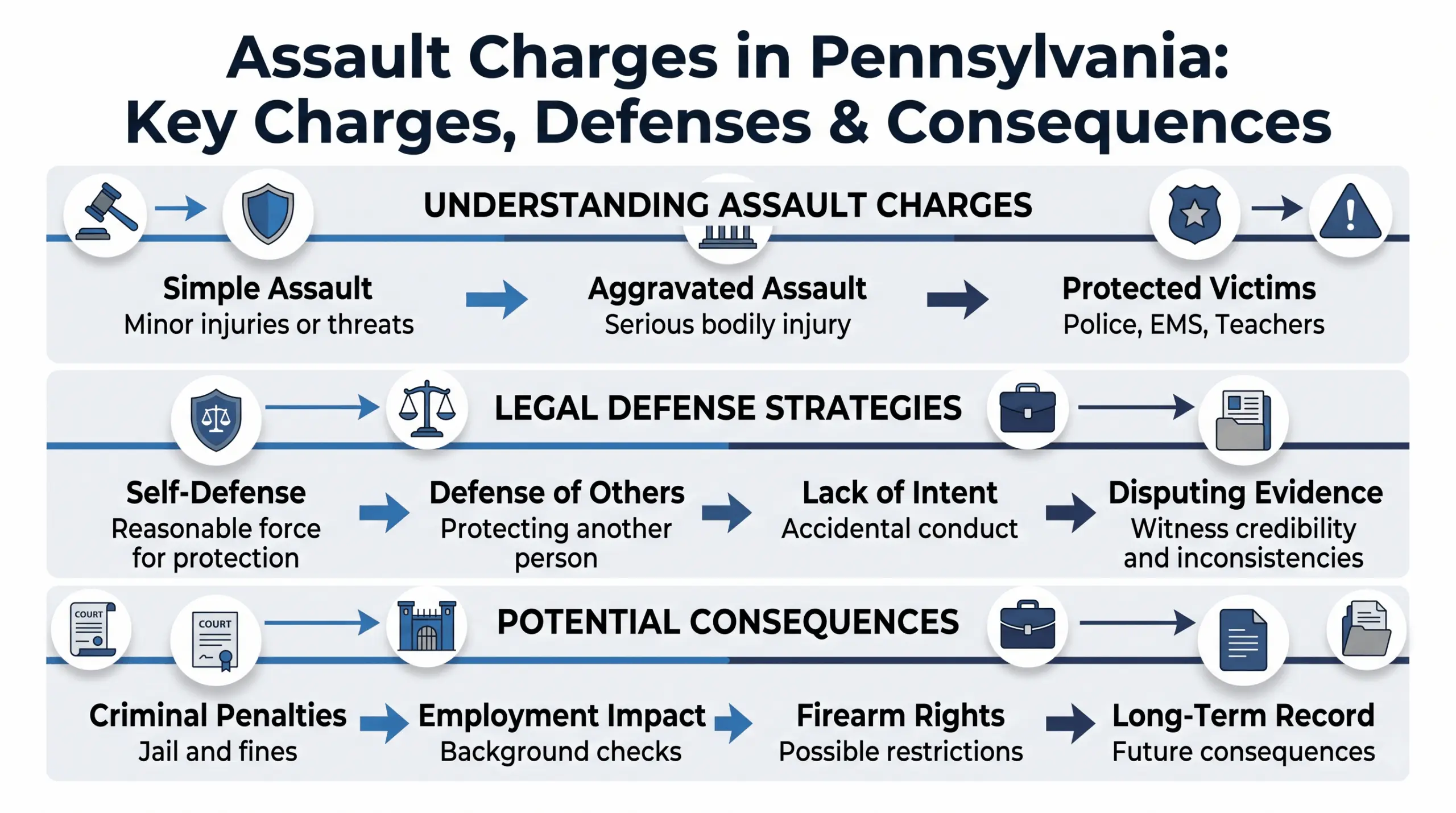
Simple Assault vs. Aggravated Assault in Pennsylvania
The most critical distinction in these cases is whether the state pursues the matter as a simple assault or an aggravated assault. This classification determines everything from the amount of your bail to the potential length of a prison sentence.
Simple Assault: Definition and Examples
Simple assault is generally classified as a misdemeanor. Under Pennsylvania law, it typically involves:
- Causing or attempting injury: Attempting to cause, or intentionally, knowingly, or recklessly causing bodily injury to another person.
- Negligence with a weapon: Negligently causing bodily injury to another person with a deadly weapon.
- Making threats: Attempting by physical menace to put another person in fear of imminent serious bodily injury.
Examples of simple assault often include:
- Striking someone during a bar fight, resulting in bruising or a minor cut.
- Shoving an individual during a heated dispute causes them to fall and scrape their knee.
- Raising a fist and threatening to hit someone in a way that causes them legitimate fear of immediate harm.
Aggravated Assault: Definition and Examples
Aggravated assault is a much more severe charge, classified as a felony. It is typically pursued when the alleged conduct involves severe harm, the use of a weapon, or is directed at protected classes of individuals. It generally involves:
- Causing serious injury: Attempting to cause serious bodily injury to another, or causing such injury intentionally, knowingly, or recklessly under circumstances manifesting extreme indifference to the value of human life.
- Assaulting protected individuals: Attempting to cause or intentionally or knowingly causing bodily injury to specific protected individuals (such as police officers, teachers, or EMS personnel) acting in the performance of their duties.
Examples of aggravated assault typically include:
- Striking someone with a heavy object or weapon, resulting in broken bones or requiring hospitalization.
- Intentionally causing severe physical trauma that carries a substantial risk of death or permanent disfigurement.
- Engaging in a physical altercation with a responding police officer or paramedic, even if the resulting injuries are relatively minor.
How Assault Charges Are Filed in Pennsylvania
Many individuals mistakenly believe that the alleged victim is the one who “presses charges” and can simply choose to drop them later. In reality, when police respond to an incident, they evaluate the scene for probable cause. If they believe a crime occurred, they may make an arrest and file a report.
From that point forward, the local District Attorney’s office takes control of the case. The Commonwealth of Pennsylvania brings the assault charges in Pennsylvania, meaning only the prosecutor or a judge has the legal authority to dismiss or reduce them, regardless of the accuser’s later wishes.
Penalties for Assault Charges in Pennsylvania
The potential penalties for an assault conviction vary drastically depending on the grading of the offense:
- Simple Assault Penalties: Generally graded as a second-degree misdemeanor, punishable by up to two years in prison and significant fines. If the incident was a fight entered into by mutual consent, it may be graded as a third-degree misdemeanor.
- Aggravated Assault Penalties: Graded as a first-degree or second-degree felony, depending heavily on the specific circumstances and the severity of the offense. While lower-graded aggravated assault convictions may carry maximum penalties of up to 10 years in prison, more serious first-degree aggravated assault offenses can carry statutory maximum penalties of up to 20 years in a state correctional institution, along with massive financial penalties.
How an Assault Conviction Affects Your Life Beyond the Courtroom
The collateral damage of a criminal conviction can quietly disrupt your life for years after your sentence is completed.
Impact on Employment and Background Checks
A conviction will appear on standard background checks, creating potential hurdles in your career. While the exact impact depends heavily on the specific employer, industry regulations, and the circumstances of your case, many employers maintain policies against hiring individuals with violent criminal records. A felony conviction may create additional barriers in certain licensed professions, regulated industries, and employment fields that require background checks.
Impact on Your Firearm Rights
An assault conviction can carry severe constitutional consequences. Certain qualifying violent felony convictions, including specific types of aggravated assault convictions, may result in the loss of your right to own, possess, or purchase a firearm under both federal and Pennsylvania law. Furthermore, certain simple assault convictions – especially those classified as domestic violence – can also result in the loss of your Second Amendment rights under federal law.
Defenses Against Assault Charges in Pennsylvania
A filed charge is not a conviction. Depending on the specific facts of your case, strategic defenses may include:
- Self-Defense: Proving that you reasonably believed force was immediately necessary to protect yourself against another person’s unlawful use of force.
- Defense of Others: Demonstrating that you acted to protect a third party who was in immediate danger of being harmed.
- Lack of Intent: Showing that the physical contact was accidental rather than intentional, knowing, or reckless.
- Disputing the Evidence: Challenging the credibility of the accuser, exposing inconsistencies in their statements, or utilizing witness testimony to present an alternative version of events.
Common Mistakes People Make After an Assault Arrest
Panic often causes individuals to make errors that inadvertently strengthen the prosecution’s case. You should generally avoid these common pitfalls:
- Explaining your side to the police: Speaking to law enforcement without an attorney present often provides prosecutors with statements that can be twisted and used against you.
- Contacting the accuser: Reaching out to apologize or ask them to drop the charges can be construed as witness intimidation or violate bail conditions.
- Discussing the incident online: Posting about the altercation on social media provides a public record of your statements.
- Assuming the charges will go away: Ignoring the situation and hoping it resolves itself rarely works when dealing with violent criminal allegations.
Steps to Take Immediately After Being Charged With Assault
To protect your freedom, you should take the following steps the moment you are involved in an altercation or are released from custody:
- Exercise your right to remain silent: Do not discuss the incident with law enforcement or investigators without legal counsel present.
- Document the aftermath: Take photographs of any injuries you sustained during the altercation, as this can be crucial evidence for a self-defense claim.
- Gather witness information: Collect contact details for anyone who may have seen the incident occur.
- Retain defense counsel: Hire a qualified criminal defense attorney immediately so they can begin building a strategic defense before critical evidence is lost.
How Penglase & Benson Can Help
At Penglase & Benson, we understand that there are always two sides to every story, especially in cases involving physical altercations. We know that good people can find themselves in highly stressful situations, and an arrest does not mean a conviction is inevitable.
Our attorneys focus on developing strategic, practical defenses for individuals facing assault charges in Pennsylvania. We will carefully review police reports, analyze witness statements, and thoroughly investigate the incident to ensure your side of the story is heard. We will advocate for you vigorously, working to protect your freedom, negotiate for charge reductions, or seek a dismissal whenever possible.
Visit our Contact Page to send us a message and schedule your free consultation today.
Frequently Asked Questions
Can assault charges be dropped if the victim doesn’t want to testify?
While a reluctant witness can make a prosecutor’s job more difficult, the accuser does not have the legal authority to simply drop the charges. The District Attorney may choose to proceed with the case using other available evidence, such as 911 call recordings, police observations, or other witness testimony.
What makes an assault “aggravated” in Pennsylvania?
An assault is generally elevated to an aggravated assault if it involves an attempt to cause, or actually causing, serious bodily injury, often with a deadly weapon. It also applies if the assault is directed at protected classes of individuals, such as police officers, teachers, or emergency medical personnel, regardless of the severity of the actual injury.
Can I claim self-defense if I threw the first punch?
Generally, self-defense requires that you were not the initial aggressor. However, there are complex legal exceptions. If you reasonably believed that the other person was about to use unlawful force against you and you had no other way to avoid it, a strategic defense might still be viable depending on the specific circumstances.
Is simple assault a felony or misdemeanor in PA?
Simple assault is typically graded as a second-degree misdemeanor in Pennsylvania. However, if the physical altercation was the result of a fight entered into by mutual consent, the charge may potentially be reduced to a third-degree misdemeanor.
Will an assault charge affect my current job?
It certainly can. While the exact impact depends on your employer and industry, a criminal arrest or conviction can create significant employment challenges. Additionally, if the court imposes restrictive bail conditions or if you are incarcerated pending trial, your inability to show up for work could result in job loss.

